
Why Does My Dog Bark at Strangers? (2026): Fear, Territory & the Calm-Down Plan
I have been on both sides: the owner of the barking dog, and the stranger on the receiving end, trying to look relaxed while a dog I have never met tells me, loudly, to leave. What I have learned: the bark is almost never random and almost never personal. Your dog is not being rude. Your dog is communicating, and once you figure out what the bark means, the fix gets clearer.
Quick Verdict: Most stranger barking comes down to fear, territory, excitement, frustration, or attention-seeking, and each one needs a different response. Start with distance and management, teach a calm alternative like going to a mat, and build up exposure slowly. If the barking started suddenly, or your dog shows signs of pain, get a vet check first.
Not All Barks Are the Same
Dog owners tend to lump every bark into one bucket: “my dog barks too much.” Trainers do not, for a practical reason. A scared dog needs reassurance and space. A dog that wants to say hello needs impulse control. Treating a fearful dog like an excited one makes the fear worse; treating an excited dog like a fearful one wastes weeks.

The Five Bark Types, Decoded
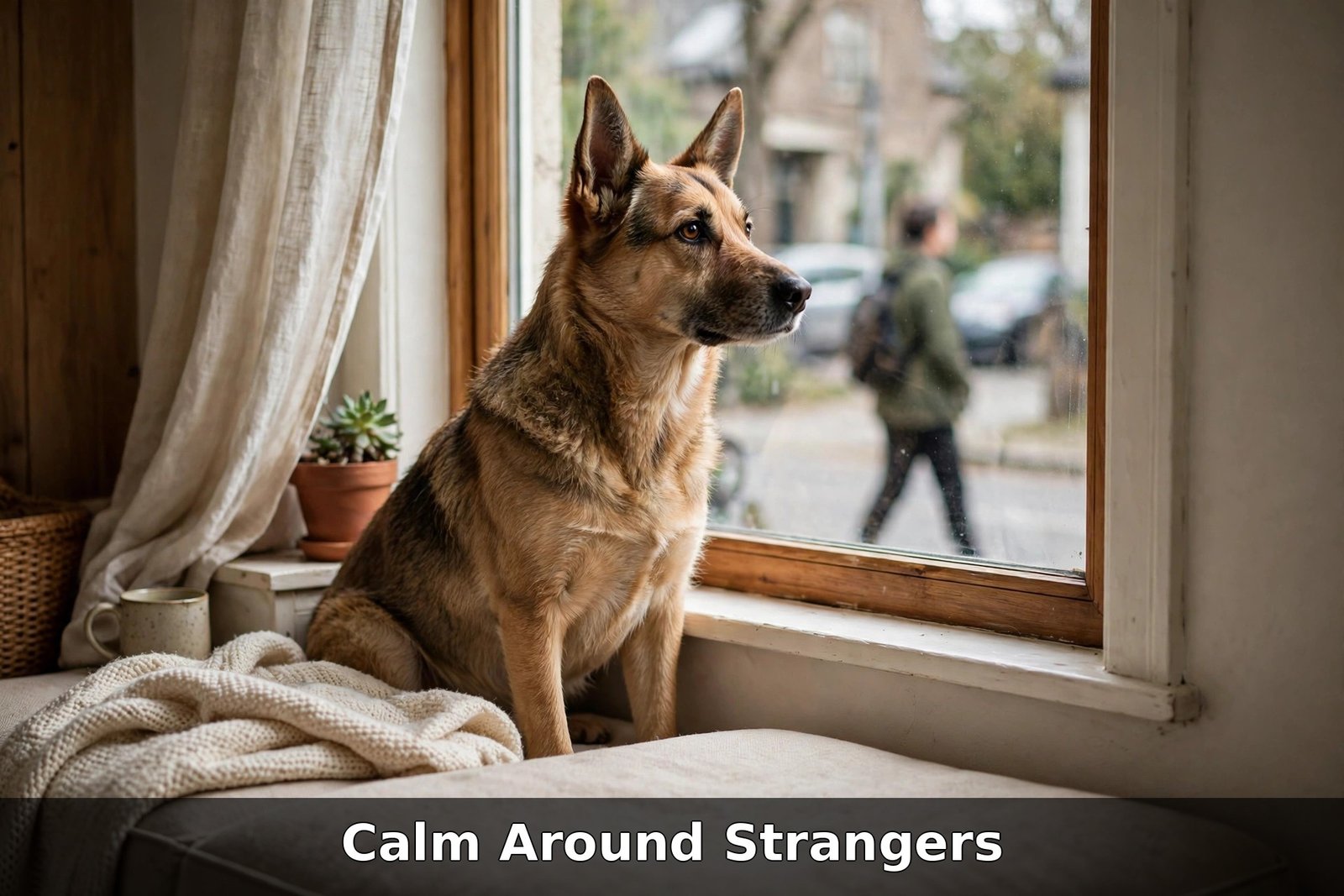
1. Territorial barking. The classic window bark. A stranger approaches the house, yard, or car, and your dog sounds the alarm. It usually starts when the person enters what your dog considers its turf and eases when the person leaves. Body language is confident: tall posture, ears forward, tail high. Your dog genuinely believes it is doing its job.
2. Fear-based barking. This one sounds frantic, and it comes with a body trying to get smaller or further away: ears pinned back, tail tucked, crouching, lip licking. The logic is simple: “If I sound scary enough, maybe this person will go away.” When the stranger leaves, the barking worked, so the dog repeats it. Fear barking is also the type most often made worse by punishment, because scolding a scared dog just confirms strangers mean trouble.
3. Excitement and greeting barking. Some dogs bark at strangers because they desperately want to meet them. The body gives it away: loose, wiggly, tail wagging in big sweeps, maybe spinning or jumping. The bark is often high-pitched and broken up by whines. Friendliest problem on the list, and also the most embarrassing at the front door, since your dog’s idea of a greeting involves lunging toward a stranger who did not ask for a hug.
4. Frustration barking. This happens when a dog can see or hear a stranger but cannot reach them: behind a fence, on a leash, behind a glass door. The barking is intense, sometimes mixed with lunging or spinning. It looks a lot like aggression, but the feeling underneath is closer to a toddler denied a toy. The barrier itself is part of the problem, which is why fence-running dogs get worse the longer the fence stays in play.
5. Attention-seeking barking. Your dog barks at a visitor, you look over, you talk to the dog, maybe you hand over a treat to quiet things down, and the dog learns a useful lesson: barking at people makes good things happen. The body language is usually relaxed, even cheeky. The dog is not stressed. The dog is running a successful business.
Bark Types at a Glance
| Bark Type | Body-Language Tells | What Your Dog Wants |
|---|---|---|
| Territorial | Tall posture, ears forward, tail high | The stranger to leave its turf |
| Fear-based | Crouched, ears back, tail tucked, lip licking | More distance and safety |
| Excitement / greeting | Wiggly, loose body, big tail sweeps, jumping | To meet the person, right now |
| Frustration | Lunging, spinning, scratching at the barrier | Access it cannot get |
| Attention-seeking | Relaxed body, looks back at you for a reaction | Your reaction, a treat, or interaction |
Read the Body Before the Bark
The bark is the last step, not the first. Most dogs broadcast their feelings for several seconds before they make a sound: a stiffening body, a hard stare, ears swiveling toward the trigger, a closed mouth. Spotting those early signals is the most useful skill in this plan, because it lets you act before your dog is over threshold and past the point of listening.

The Calm-Down Plan
Step 1: Manage distance first. Distance is your best friend and your cheapest tool. A dog that barks at strangers from ten feet away may be perfectly calm at thirty feet. Find the distance where your dog notices a stranger but can still think, and start there. Cross the street. Walk at quieter times. This is not avoidance forever. It is a starting point where learning is actually possible.
Step 2: Fix the window and fence problem. If your dog spends the day patrolling the front window, that window rehearses the barking habit hundreds of times a week. Block the view with frosted film, move the dog’s bed away from the front of the house, and limit unsupervised yard time if fence-running is the trigger. You are closing a rehearsal studio.
Step 3: Teach “go to mat” as the alternative. Dogs need a job to do instead of barking, and “go to your mat” is one of the best. Start with no distractions: lure your dog to the mat, reward settling, build duration a few seconds at a time. Then add the doorbell, then a real visitor at a distance. The goal is a dog that hears the door and thinks “mat means good things” instead of “stranger means alarm.” If your dog also mobs visitors, our guide on how to stop your dog jumping on guests pairs well with this step.
Step 4: Controlled exposure, in tiny steps. Practice with strangers at a distance where your dog stays under threshold. Reward calm looking or turning back to you. If your dog tips over into barking, you went too close or stayed too long. No drama, just add distance and try again shorter next time. Three five-minute wins in a week beat one miserable thirty-minute walk.
Step 5: What NOT to do. Do not punish fear barking. Yelling, leash jerks, spray bottles, and shock collars might suppress the noise for a day, but they do not change the feeling underneath, and with a fearful dog they usually make it worse. The dog learns strangers predict scary consequences. Also, do not force greetings. Letting a stranger corner a nervous dog to “show it people are friendly” is one of the fastest ways to create a bite risk. If your dog moves away, let it.
When to Get Professional Help
Most stranger barking improves with management and the steps above, but two situations call for help rather than DIY. First, a sudden change: a dog that never barked at strangers and suddenly starts, or becomes snappy alongside the barking, should see a vet first. Pain, hearing or vision changes, and thyroid or neurological issues can all show up as behavior changes, and no training plan fixes a medical problem. Second, genuine aggression: lunging with intent to bite, hard staring with a stiff frozen body, or any bite history. That is a job for a qualified, certified behaviorist, not a blog post. No shame in that. It is the responsible call.
Barking and anxiety often travel together. If your dog panics when left alone too, read our guide on the signs of separation anxiety in dogs, and if nights are the worst time, our piece on how to stop dog barking at night covers the after-dark side.
A Gentle Bridge: Calming Support
Training does the heavy lifting, but some dogs benefit from a little extra help taking the edge off while they learn. Think in general categories rather than miracle fixes: long-lasting chew toys and puzzle feeders, snug pressure wraps that some dogs find settling, calming pheromone diffusers, and lick mats for decompression after a stressful walk. None of these replace training, and none will single-handedly stop barking. Used alongside the plan above, they can lower the baseline just enough that your dog can actually learn. If anxiety is severe, talk to your vet about options.
One last thought: progress is rarely a straight line. Your dog will have a brilliant week and then bark its head off at a jogger on a bad day, and that bad day does not erase the good week. Keep the distance generous, keep the rewards coming, and keep going. On the fear side, our guide on why dogs are scared of thunder explains how the same fear logic works with noises.
Frequently Asked Questions
Why does my dog only bark at certain strangers?
Dogs read a lot we miss: hats, hoods, beards, uniforms, unusual gaits, strong scents. A dog that barks at bearded men but loves women is not being difficult. It is reacting to a pattern it has not been socialized to. Gradual exposure to that type of person, at a comfortable distance, usually works better than generic socialization.
Should I let strangers give my dog treats to make friends?
Only if your dog actually wants to approach, and only with the stranger tossing the treat gently to the side rather than luring the dog in close. A nervous dog that creeps forward for a treat and then finds itself trapped next to a stranger often panics. Let the dog choose the distance.
Is it too late to train an older dog that barks at strangers?
No. Older dogs learn just as well, and often faster, because they have better impulse control than puppies. The habit may be more ingrained, so progress can be slower, but I have seen senior dogs go from window alarm systems to calm watchers with consistent mat work and distance management. Age is not the obstacle.
How long does it take to see improvement?
With consistent management, most owners notice small changes within two to four weeks: a shorter barking burst, a quicker recovery, a dog that looks to them before exploding. Bigger change, like calmly watching a stranger pass, typically takes a few months. Fear-based cases take the longest. If nothing changes after a month of consistent work, bring in a behaviorist.
🎄 Visit Our Etsy Shop — Fukroo
Printable Christmas wall art, gift tags & party games — instant download
Shop on Etsy →


One Comment