How to Choose the Best Christmas Dog Harness (2026): Fit, Visibility & Festive Prints That Actually Work
Many festive harnesses are designed for photos first. Jingle bells along the chest strap can unsettle a dog within minutes, and dark tartan fabric does little to make a dog visible to drivers on a winter evening.
That is the idea this guide is built on: a Christmas harness is walking gear first and a festive outfit second. Fit, control, and being seen in the dark are what actually matter — and most festive harnesses get at least one of those wrong.
Quick Verdict: A well-fitting padded harness with reflective trim is the best Christmas pick for most dogs — add a festive print if you like, but never trade padding, fit, or visibility for it. For dark winter walks, an LED harness beats a printed one every time. Measure your dog’s chest before you order.
Why a Christmas Harness Is Not Just a Pretty Collar
A harness spreads pressure across your dog’s chest and shoulders instead of concentrating it on the neck. That matters more in December: dogs pull harder around Christmas crowds and fireworks, and a collar on a pulling dog can choke and strain the throat. A harness also gives you a handle for steering your dog away from a dropped mince pie or a toddler with a chocolate Santa.
Christmas adds two things a normal harness does not have to deal with. First, darkness: most weekday walks in December happen before sunrise or after sunset, so visibility becomes the main safety feature. Second, the festive trap: sellers dress weak harnesses in tartan and reindeer print and charge a premium. The print hides thin straps, plastic buckles, and a fit that was never tested on a real dog.
The 5 Harness Types, Compared
| Harness type | How it works | Best for | Watch out for |
|---|---|---|---|
| Step-in festive harness | Steps in, clips over the back | Calm dogs; quick on-and-off | Escapes if too loose; little pull control |
| Padded vest harness | Padded chest panel, back-clip lead | Most dogs; daily winter walks | Can run warm indoors |
| Front-clip no-pull harness | Lead clips at chest, turns dog toward you | Pullers; strong dogs; training | Can twist; needs adjusting |
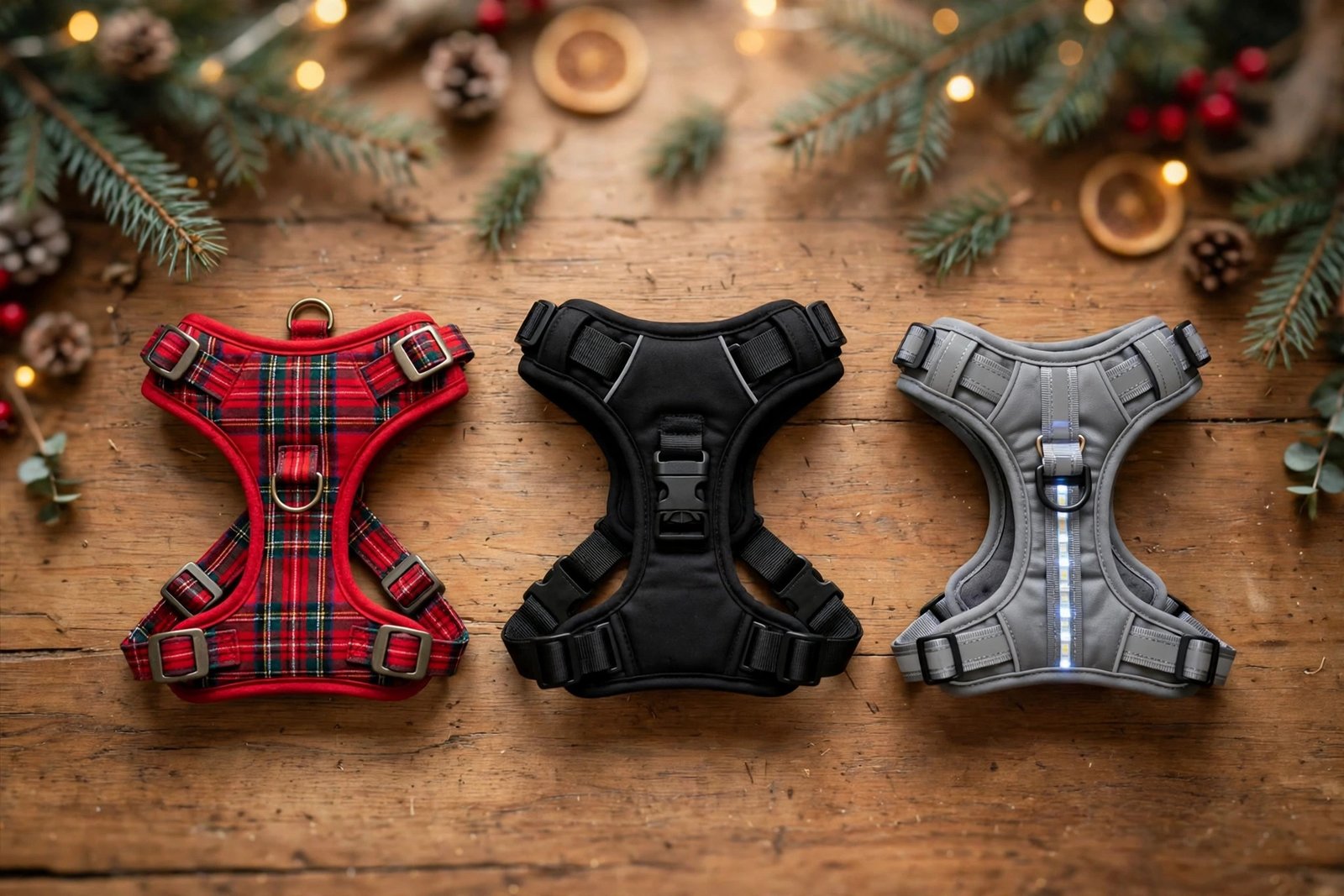
| Reflective harness | Reflective stitching, seen in headlights | Dark morning and evening walks | Trim can be a thin token strip |
| LED light-up harness | Light strip, glows on its own | Rural lanes; off-lead areas; fog | Battery life; charging cable; washability |
The Five Harness Types in Detail
1. The step-in festive harness — Best for: calm dogs and owners who want the harness on fast. Your dog steps its front paws into two loops and you clip the straps over the back. Watch out for: escape artists. A step-in that is even slightly loose lets a nervous dog back out of it in one move — and Christmas is full of things that make a dog nervous.
2. The padded vest harness — Best for: most dogs, most of the time. A wide padded chest panel spreads the load and the back-clip lead keeps things simple. Pick a festive print on a proper padded vest and you get the look without giving anything up. Watch out for: fake padding — some festive vests are a single layer of printed fabric with no padding at all. Press the chest panel before you buy.
3. The front-clip no-pull harness — Best for: dogs that pull or lunge on a Christmas walk. The lead clips at the chest, so a pulling dog turns gently back toward you. Watch out for: twisting. A front-clip harness needs its straps adjusted properly or it slides sideways — take five minutes to fit it at home before the first real walk.
4. The reflective harness — Best for: anyone walking before sunrise or after sunset, which in December is nearly everyone. Reflective stitching and panels catch car headlights and make your dog visible from a long way off. Watch out for: token trim. Some festive harnesses have a single thin reflective line and call themselves “high visibility” — look for reflective material on the chest, sides, and back, not one stripe.
5. The LED light-up harness — Best for: rural lanes, parks with no streetlights, and foggy mornings. Unlike reflective trim, an LED strip makes its own light — drivers see your dog before their headlights reach it. Watch out for: the battery and the washing instructions. Check how it charges, how long a charge lasts, and whether the light strip comes out before washing.
Measure Before You Buy (Two Minutes, No Guessing)
Never buy a harness by breed or by weight alone — both lie. Take three measurements with a soft tape measure: chest girth just behind the front legs, neck circumference at the base of the neck, and back length from neck to tail. Then check them against the maker’s size chart, not a generic small-medium-large label.
Then do the two-finger test: with the harness on, you should be able to slide two fingers flat under every strap. Less than that and it is too tight — it will rub raw patches behind the front legs within a week. More than that and the dog can slip it. Walk your dog around the house for ten minutes in a new harness first: watch for chafing behind the elbows, a change in gait, or freezing, which usually means something pinches.
Visibility: Reflective Trim vs LED Lights
This is the decision that matters most for a Christmas harness, and it is simpler than sellers make it sound. Reflective trim is passive: it only shines when light hits it, so it works well on lit streets and poorly on dark lanes. It costs nothing to run, never needs charging, and survives the washing machine. LED light is active: it glows on its own, so drivers see your dog from much further away. It needs charging and costs more, but on an unlit road it is the difference between being seen and not.
My rule: if your walks are on lit pavements, a padded harness with good reflective trim is enough. If any part of your route is unlit — a park path, a country lane, a canal towpath — go LED. And whatever you choose, add a clip-on light as a backup: harnesses get muddy, straps twist, and a second light costs almost nothing.
Festive Prints: What Works and What to Avoid
Tartan, reindeer, snowflakes, and holly prints are all fine — the print itself never hurts a dog. What hurts is everything sellers attach to it. Jingle bells sewn near the ears will stress a noise-sensitive dog for a whole walk. Glued-on antlers, pom-poms, and sequins are chew targets: a bored dog will pull them off and swallow them. Loose ribbon ties snag on fences, and a “Santa suit” harness can block the dog’s vision or overheat it indoors.
The safe festive look is simple: a good harness in a Christmas print, decoration in the fabric itself — woven tartan, printed snowflakes — and nothing dangling, glued, or jingling. If you want antlers for the family photo, put them on for the photo and take them straight off.
What to Avoid in Any Christmas Harness
Five red flags — any one is enough to put a harness back on the shelf. One: “one size fits all” — no harness fits all dogs. Two: plastic buckles that feel thin and flex when you squeeze them; a strong dog will snap one. Three: no size chart, or a size chart measured in breed names instead of centimetres. Four: a harness sold as “costume” rather than walking gear — it was designed for photos, not for holding a pulling dog. Five: no reflective material at all on a harness sold for winter — the maker was not thinking about December walks.
Also skip matching lead-and-harness sets where the lead is an afterthought: a thin festive lead with a weak clip undoes everything a good harness does.
Frequently Asked Questions
What is the best Christmas harness for a dog?
A padded vest harness with reflective trim, in the right size, is the best Christmas pick for most dogs — comfortable for long walks and visible after dark. Add LED if your route includes unlit roads or paths.
How do I measure my dog for a harness?
Measure the chest girth just behind the front legs, the neck at its base, and the back length from neck to tail. Check those numbers against the maker’s size chart — never buy by breed or weight alone. Then use the two-finger test under every strap.
Are festive dog harnesses safe?
Yes, if the harness underneath the print is a proper walking harness: padded chest, strong buckles, adjustable straps, and reflective trim. Skip glued-on decorations, jingle bells near the ears, and dangling ribbons.
Should I buy a reflective or LED harness for winter walks?
Reflective trim is enough on lit streets. An LED harness is better on unlit lanes, parks, and foggy mornings because it makes its own light. If you walk anywhere without streetlights, go LED.
Can my dog wear a Christmas harness all day?
No. A harness is for walks and outings, not all-day wear. Take it off indoors so the straps do not rub and the dog can rest properly. Dry it before the next walk if it is wet or muddy.
What harness is best for a dog that pulls?
A front-clip no-pull harness, fitted properly, gives you the most control over a strong puller. Pair it with short, calm training sessions — no harness trains a dog by itself.
For more of the Christmas season with your dog, see our guides to the best Christmas dog treats, best Christmas dog toys, best dog Christmas sweater, and best winter coat for dogs.
🎄 Visit Our Etsy Shop — Fukroo
Printable Christmas wall art, gift tags & party games — instant download
Shop on Etsy →