
Best Carpet Rake for Pet Hair: Remove Embedded Hair Fast
This article contains affiliate links. If you buy through a link on this page, Furveko may earn a small commission at no extra cost to you. It never changes which products we recommend.
You vacuum, the carpet looks fine for an hour, then the light catches it: pale threads of hair worked deep into the pile along the skirting boards and where the dog sleeps. Vacuums lift what sits loose, not hair walked on and pushed down between fibres for weeks.
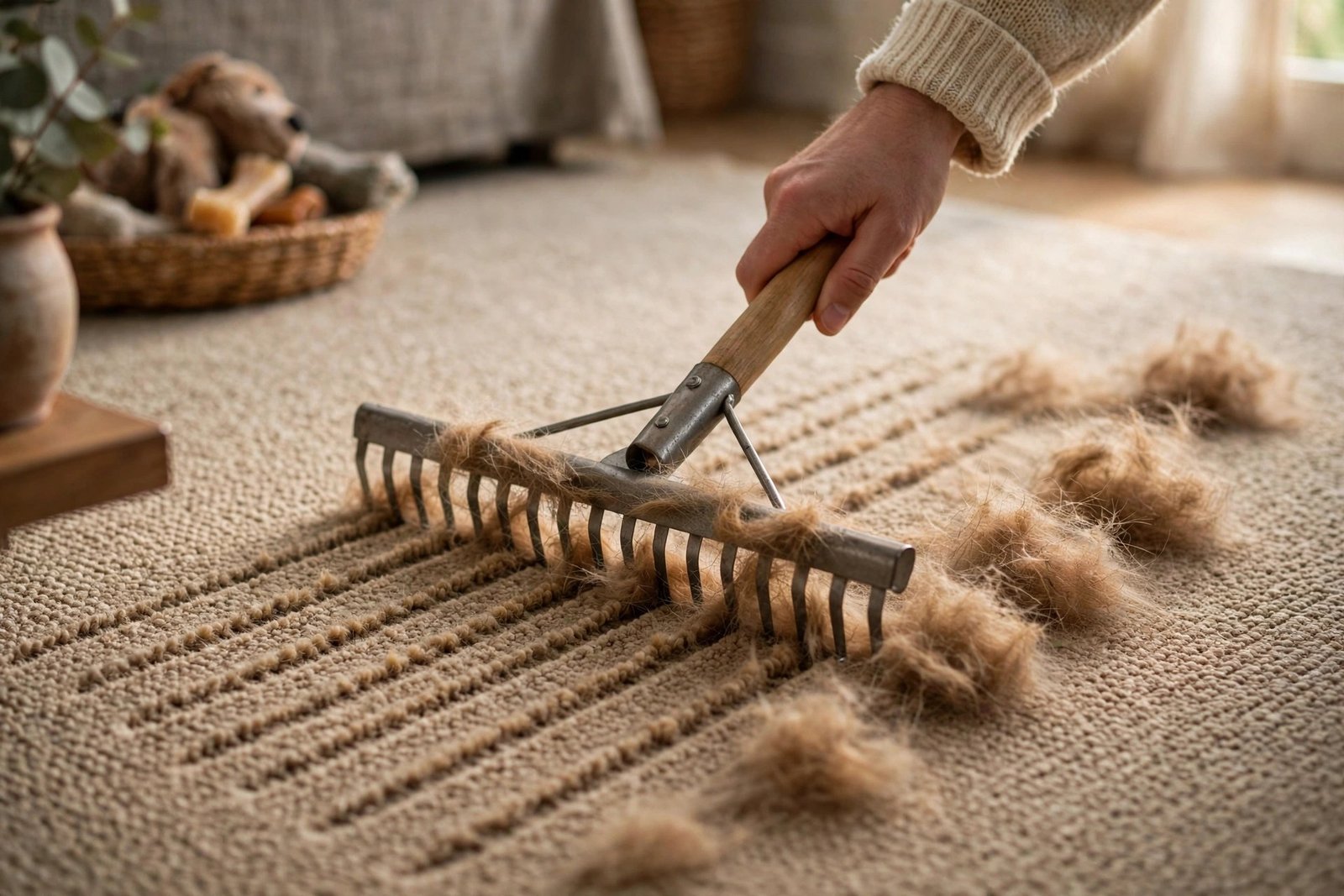
A carpet rake works before the vacuum, not instead of it: raking lifts embedded hair into clumps the vacuum can then remove. Below we compare wide metal rakes, rubber brooms, dual-sided tools, hand scrapers, hand brushes and a grooming blade that also works on carpet. One warning: metal edges dig best, but they can snag looped or delicate fibres.
Quick Verdict
- Best overall: Grandi Groom-style metal carpet rake — wide head, long handle, whole rooms standing up.
- Best safe first rake: FURemover rubber broom with squeegee — gentle on nearly every pile.
- Best two-in-one: Fido Fave-style dual-sided rake — metal edge for deep hair, silicone edge for delicates.
- Best for stairs and edges: Handheld metal pet hair scraper.
- Best for spot work: Rubber-bristle hand brush — cheap and precise.
- Best for heavy shedders: SleekEZ-style deshedding blade, used gently on carpet.
Looped, Berber or wool carpet? Skip the metal and start with rubber.
Comparison Table
| Product | Best for | Type | Reusable |
|---|---|---|---|
| Grandi Groom-style Carpet Rake | Whole rooms, medium pile | Wide metal rake, long handle | Yes |
| FURemover Rubber Broom | Safe all-rounder, mixed floors | Rubber bristles + squeegee | Yes |
| Fido Fave-style Dual-Sided Rake | Deep hair + delicate spots | Metal edge / silicone edge | Yes |
| Handheld Metal Hair Scraper | Stairs, edges, car carpet | Small metal-edge scraper | Yes |
| Rubber-Bristle Hand Brush | Spot cleaning, rugs | Hand brush, rubber bristles | Yes |
| SleekEZ-style Deshedding Blade | Heavy shedding, low/medium pile | Serrated blade in hand block | Yes |
Prices change often on Amazon, so use the Check Price on Amazon link under each product for the current price.
The Products, Honestly Reviewed
1. Grandi Groom-Style Carpet Rake — Best Overall
The professional style, scaled for home: a wide head around 45 cm with stiff teeth on a long handle, used standing up. Pull it towards you slowly and hair rolls out of the pile in grey ropes.
The width is the point — nobody rakes a living room on their knees twice a month. This makes a room a ten-minute job. Best on low to medium cut pile, which covers most living rooms.
Pros
- Wide head and long handle — whole rooms without kneeling
- Reaches deep; lifts hair the vacuum missed entirely
- Nothing to refill or recharge
Cons
- Too aggressive for looped, Berber or delicate wool
- Clumsy on stairs and in tight corners
- Bulkiest to store
2. FURemover Rubber Broom — Best Safe All-Rounder
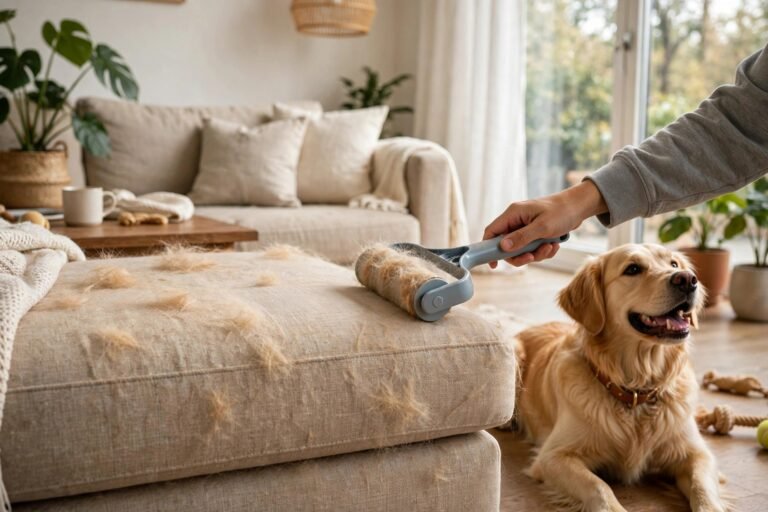
If metal near your carpet makes you nervous — and on some carpets it should — start here. Rubber bristles build friction and static, gathering hair into clumps you pick up or vacuum away; a squeegee edge helps on rugs and spills.
It will not dig as deep as metal and mostly skims high pile, but it is very hard to damage any carpet with it, and it crosses onto rugs, hard floors and upholstery. For plenty of homes, this plus a vacuum is the whole routine.
Pros
- Safe on virtually every pile, including loops and delicates
- Works across carpet, rugs and hard floors
- Rinses clean under the tap
Cons
- Shallower than metal — deepest hair stays
- Cannot reach the base of high pile
- Slower over large rooms
3. Fido Fave-Style Dual-Sided Rake — Best Two-in-One
One room often holds two jobs: tough main carpet and a thinner rug. These put metal teeth on one side and a soft silicone edge on the other. Flip the tool and you go from firm to gentle.
Use metal for the bulk of the room, silicone for edges and fragile patches. The trade-off is size — a handheld or short handle means whole rooms take longer.
Pros
- Firm and gentle edges in one tool
- Ideal where tough carpet meets delicate rugs
- Compact and easy to store
Cons
- Small head, slower coverage
- Metal side still needs a hidden-area test
- Not ideal for stairs
4. Handheld Metal Hair Scraper — Best for Stairs and Edges
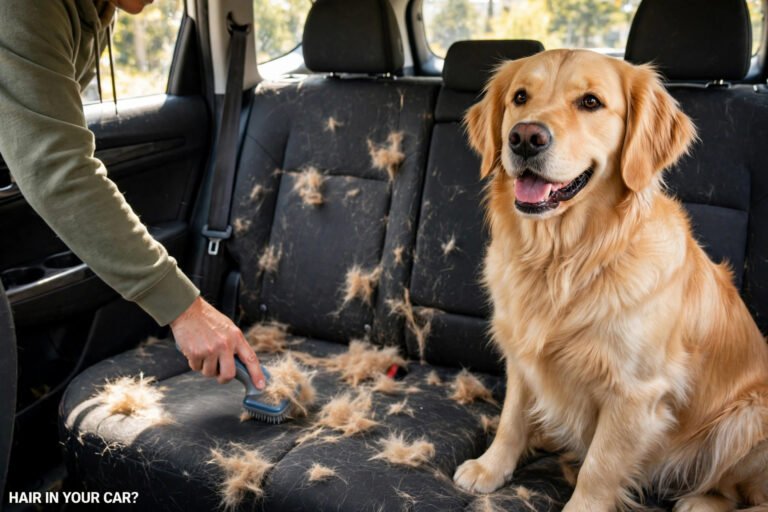
Carpeted stairs defeat wide tools: narrow steps, hair trodden hardest where feet land, edges the vacuum misses. A small block with a firm metal edge does this job properly — short, firm strokes lift dense nests of hair compacted flat for months.
Also earns its place along skirting boards, in car footwells and on rug corners. A detail tool, not a room tool.
Pros
- Right size for stairs, corners, edges and cars
- Excellent on compacted, walked-in hair
- Small, tough and inexpensive
Cons
- Hands-and-knees work — not for whole rooms
- Metal edge can snag loops; light pressure, test first
- Hard on the wrist over a full staircase
5. Rubber-Bristle Hand Brush — Best for Spot Work
Often the problem is not the whole carpet; it is one patch in front of the sofa where the dog sleeps. Short strokes in two directions ball the hair up; lift it off the bristles and carry on.
Cheap, silent and safe on almost anything, including clothes. It lacks a metal rake’s depth and is slow over area — but for favourite spots, many owners reach for this most.
Pros
- Total control — perfect for favourite spots and rugs
- Gentle bristles, safe on delicate fibres
- Very affordable, multi-surface
Cons
- Small coverage, slow on big areas
- Moderate depth on heavy build-up
- Bristles wear with daily use
6. SleekEZ-Style Deshedding Blade — Gentle on Carpet
This began as a grooming tool: a fine serrated blade in a shaped block that pulls loose undercoat from dogs and horses. Dragged lightly across low and medium pile carpet, the teeth catch fine hair rubber slides over, and it comes up in sheets.
Be gentle — this is the easiest tool to overdo. Use a light, floating stroke and test on a hidden patch first. Used on the dog itself, it also means less hair reaches the carpet.
Pros
- Superb on fine hair in low and medium pile
- Grooms the pet and cleans the carpet
- Comfortable grip for longer sessions
Cons
- Needs a light hand on delicate pile
- Not for looped, shag or high pile
- Blade dulls and eventually needs replacing
Carpet Rake vs Vacuum: Why Order Matters
A rake does not make the vacuum redundant; it makes the vacuum work. Airflow lifts loose debris, but hair woven down between fibres, wrapped at the base of the tufts, survives pass after pass.
So: rake first, then vacuum. The rake piles the hair on top; one vacuum pass collects it, plus the fine dust raking disturbed. Rake before every second or third vacuum in the dog’s main rooms, plus a full deep rake monthly.
Choosing by Carpet Pile Type
Low pile (short, dense carpet, most tiles): almost everything works. Metal rakes and the deshedding blade shine here.
Medium pile (most living-room carpet): the sweet spot for the wide metal rake and the dual-sided rake. Work in two directions — towards you, then diagonally — because one direction leaves half the hair.
High pile: stay gentle. Rubber first, then metal with light pressure, lifting rather than digging.
Shag and very long pile: no metal. Rubber bristles only, worked slowly.
Looped pile and Berber — the key warning: loops are single yarns bent into the backing, and a metal tooth that catches one can pull or snag it, even start a run. Keep metal rakes, scrapers and blades off loops entirely; use the rubber broom or the silicone edge of a dual-sided rake. Same caution for delicate wool: test somewhere hidden first.
The 10-Minute Rake Routine
- Clear the floor (1 min). Dog bed and toys out of the way.
- Traffic lanes first (3 min). Doorways, the back-door route, the sofa front. Long, slow pulls towards you, herding hair into lines.
- Change direction (2 min). Cross the same area diagonally. Expect a surprising second wave.
- Detail the edges (2 min). Hand scraper or brush for stairs, skirting edges and corners.
- Vacuum it up (2 min). One steady pass collects everything loosened. Empty the vacuum after — raked carpets fill it fast.
Weekly in the main room, monthly elsewhere — done.
Frequently Asked Questions
Will a carpet rake damage my carpet?
Rubber tools will not. Metal edges can snag looped, Berber, wool or worn carpet, so test somewhere hidden first and use light pressure.
How often should I rake with a dog in the house?
Weekly in the main room, monthly elsewhere. In spring and autumn shedding season, twice a week where the dog sleeps keeps things level.
Should I rake before or after vacuuming?
Before, always. Raking lifts embedded hair to the surface; vacuuming then removes it.
Can I use a carpet rake on rugs?
Yes, matched to the rug. Low and medium pile rugs take gentle metal or rubber well — pin the edge with your foot. Valuable rugs get rubber only, after a hidden-corner test.
Does raking replace deep cleaning?
No. It removes hair and loose debris, not ground-in dirt at the pile base. It keeps carpet looking right between proper cleans.
Final Verdict
For a typical low or medium cut-pile carpet, buy the Grandi Groom-style metal rake first — ten standing minutes, and what it pulls from a “just vacuumed” carpet is convincing. Add the handheld scraper if you have carpeted stairs.
Choose the FURemover rubber broom for looped, Berber, wool or delicate carpet; take the dual-sided rake for mixed floors; keep the rubber hand brush for the dog-bed corner. Two rules: rake before you vacuum, and test metal somewhere hidden first.


One Comment