
As an Amazon Associate, Furveko earns from qualifying purchases made through links on this page, at no extra cost to you. See our Affiliate Disclosure.
Why Does My Dog Pee on the Christmas Tree? (2026): Marking, Stress & the Dry-Floor Fix
Disclosure: This guide is general information, not veterinary or behaviourist advice. It contains no affiliate links. It explains why dogs mark the Christmas tree and how to stop it calmly.
Quick Verdict
Most dogs pee on the Christmas tree because they are marking it, not because they forgot their training. A tree is a big new object that smells strange and stands in the middle of their territory, and may already carry other animals’ scent. Guests, a changed routine, and fewer trips outside make the tree the obvious target. The fix is calm: more toilet breaks, supervision, a barrier, and an enzyme cleaner so the smell does not invite a repeat. Sudden, frequent peeing, or straining or blood, means see a vet.
First, Work Out What Kind of Peeing This Is
Not every puddle means the same thing. Marking is a leg lifted and a small amount on a vertical surface. An accident is a full bladder on the floor. A medical problem usually means little and often, and the dog looks uncomfortable.
| Type | What it looks like | When it happens | First step |
|---|---|---|---|
| Marking | Small amount on the trunk | After the tree goes up | Supervise, block access |
| Accident | A full puddle on the floor | Long gaps between breaks | More trips outside |
| Medical cause | Little and often, straining, blood | Suddenly, in a reliable dog | See a vet |
Marking is the most common answer at Christmas, and the one owners take most personally. It is not spite — marking is how dogs leave a note: I was here, this is mine. Accidents differ: a puppy still learning, an older dog with a weaker bladder, or any dog six hours without a break can run out of time. December makes it worse: cold mornings mean shorter walks, and nobody knows who last let the dog out.
Why the Tree Specifically
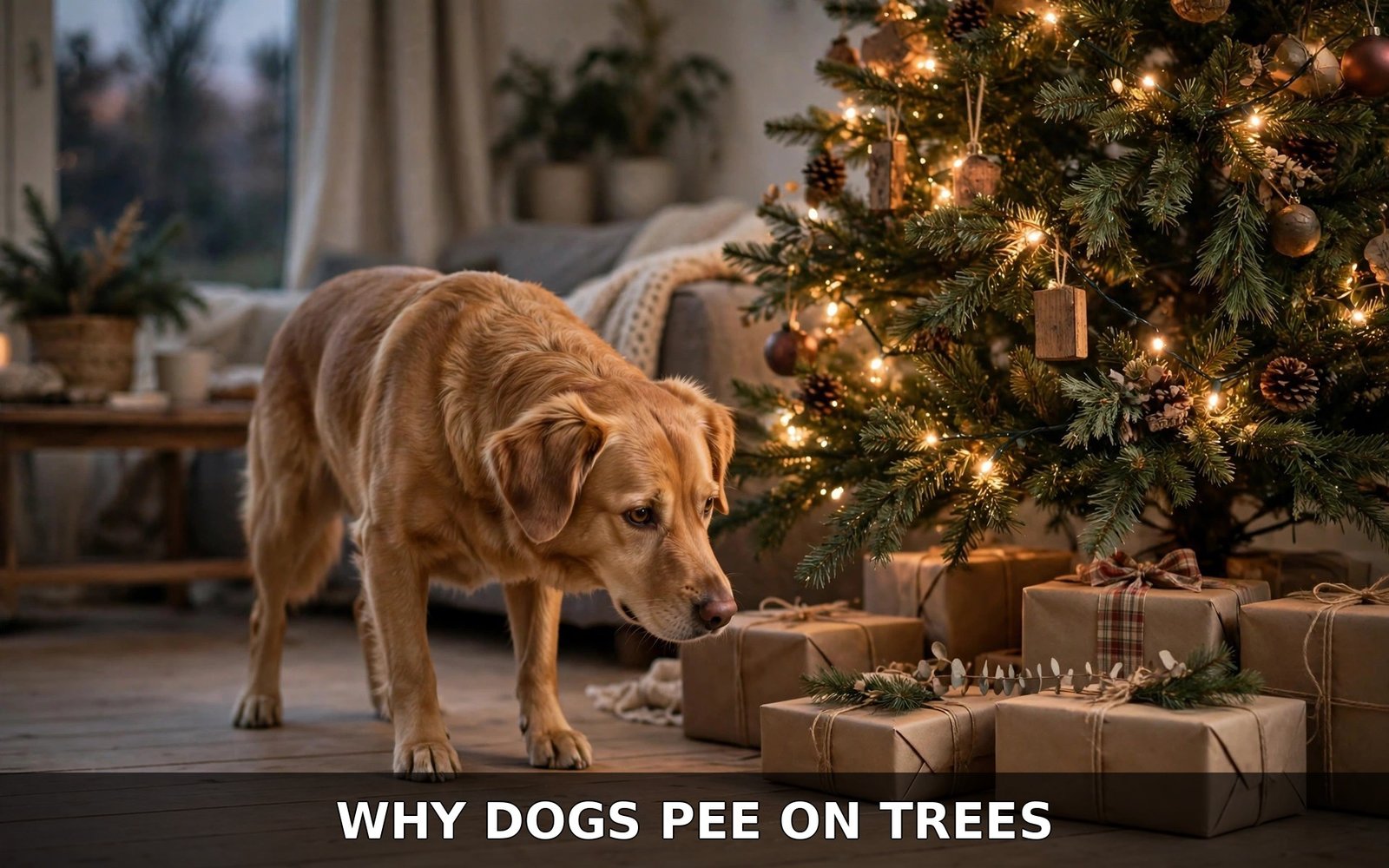
To us, the tree is decoration. To a dog, it is a piece of the outdoors in the living room, and dogs pee on outdoor things. A real tree smells of sap and soil, and may carry the scent of passing animals. An artificial one still arrives from a box in the loft, carrying dust. Either way, it is a tall new object in a room that used to be predictable.
The shape matters too. Dogs mark vertical things: fence posts, lamp posts, sofa corners. A tree trunk is a perfect target at the right height, with low branches for cover. The presents underneath smell of shops and strangers’ houses. Some dogs drink from the water in the tree stand, so keep it covered. And some dogs are not marking at all — they are scared. A dog that has never seen a tree indoors may find the lights and changed room unsettling, and fear can loosen a bladder. Our guide to why dogs are scared of the Christmas tree covers that side.
The Stress Factor
Christmas changes everything a dog relies on: the furniture moves, new people arrive, children run around, and cooking smells fill the house. Dogs love routine, and December takes it away. Stress does not always look like shaking or hiding — it often shows up as restlessness, pacing, or marking. A dog unsure of its place will try to make the house smell more like itself — the tree is the newest thing to claim. Unneutered males mark most, but females, neutered dogs, puppies, and older dogs do it too. If your dog only marks when visitors bring their dog, the trigger is the other dog.
The Step-by-Step Fix
The fix is a few small changes, done together. Most dogs stop within days.
Step 1: Go back to puppy rules. While the tree is up, take the dog out first thing, after every meal, after play, and last thing at night. Cold and excitement fill a bladder faster, so add trips. A quiet “good” and a small treat outside is praise enough.
Step 2: Supervise, or separate. A dog cannot mark the tree while you are watching it. Keep the dog where you can see it, and when you leave the room, put it in another room or behind a baby gate. Most marking happens when nobody is looking.
Step 3: Put something between the dog and the tree. A small pen or low fence around the tree works better than any spray. A ring of panels, or a baby gate across the doorway, is enough — the tree stays visible, but the dog cannot reach the trunk. A fence changes the look of the tree; a puddle changes it far more.
Step 4: Give the dog a better job. When the dog walks toward the tree, call it to you, ask for a sit, and give it a treat. You reward the choice to walk away, not the interest in the tree. In a few days the dog checks in with you instead.
Step 5: Keep the tree boring. Do not hang edible decorations low, and do not put the dog’s toys or treats under the tree. Food smells pull a dog toward the trunk. Keep family presents under the tree and the dog’s things in its bed.
Step 6: Be patient for two weeks. A habit that paid off for a week does not vanish overnight. Keep the barrier up until a full week passes without an attempt. Taking the fence down early brings the habit back.
Cleaning That Actually Removes the Scent
Cleaning matters more than most owners think. If the tree still smells of pee to the dog, it will go back to the same spot. Ordinary cleaner and bleach are not enough, and ammonia smells like urine to a dog — it can draw it back.
Use an enzyme cleaner: these break down the proteins in urine instead of covering the smell. Blot first, then soak the area and leave it for the time on the label, usually ten to fifteen minutes. On carpet, blot and repeat rather than rubbing, which pushes urine deeper. Lift the tree skirt and clean underneath it too. Our guide to the best enzyme cleaner for dog urine covers carpets, hard floors, and fabric.
What NOT to Do
Never shout at a dog for peeing on the tree, and never rub its nose in it. A dog shouted at after the event has no idea why — it just learns its owner sometimes gets angry near the tree. One shouted at during the event learns to wait until nobody is watching. Do not punish hours later either: dogs live in the moment, so a morning scolding for a midnight puddle only confuses a nervous dog. Deterrent sprays are no better — strong to us, faint to a dog, and gone in hours. A barrier and a clean floor beat a spray every time.
When to See a Vet
Most tree marking is behaviour, fixed by training — not all of it. See a vet promptly if peeing starts suddenly in a reliable dog, if the dog goes little and often, strains, cries, passes blood, drinks far more water than usual, or seems in pain — these can be signs of a urinary infection or other medical problems, and no training fixes those. Older dogs deserve a vet visit sooner: ageing weakens the bladder, and a dog that smells and sees less well may feel less secure. Never give a dog medicine meant for a person.
Pros and Cons
Pros: the fix needs only a gate or a pen and a bottle of enzyme cleaner; most dogs improve within a week; the same routine helps with other Christmas problems, like counter surfing; a calm approach keeps the dog’s trust intact.
Cons: it takes daily effort all season; a barrier changes how the room looks; a deeply anxious dog may need a behaviourist too; if the cause is medical, training alone will not work until the vet has seen the dog.
Frequently Asked Questions
Why does my dog pee on the tree but nowhere else?
Because the tree is the one new, strange-smelling, vertical object in a house the dog knows well. Marking targets new things, not random spots — block the tree and it usually stops.
Will neutering stop my dog marking the tree?
It often helps, especially in young males, but it is not a switch. A dog that has marked for years has a habit as well as a hormone, and the habit still needs training.
My puppy pees near the tree every day. Is it marking?
Probably not. Puppies under six months rarely mark — they are usually just caught short after hard play. Take the puppy out more often.
Can I stop it when we visit family?
Yes, with the same rules in a smaller package. Take the dog out as soon as you arrive, keep it beside you near the tree, and bring its bed. If the family dog has marked the tree before, yours will want to add its mark, so watch the first hour. Our guide to Can Dogs Visit Santa? covers festive outings with a dog still learning the rules.
The Bottom Line
A dog that pees on the Christmas tree is usually marking a strange new object in a changed house. The fix is calm and steady: more toilet breaks, eyes on the dog, a barrier around the trunk, and an enzyme cleaner. Give it two weeks — most dogs settle and the floor stays dry. If the peeing came on suddenly or the dog seems unwell, the vet comes before the training plan.
If cleaning is the part you keep putting off, start there — a floor that still smells of old marks undoes the rest of the work. Our guide to the best enzyme cleaner for dog urine covers carpets and hard floors. And if the sounds unsettle your dog too, our guide to why dogs are scared of Christmas music covers the volume ladder.
Disclosure: Furveko is an independent guide. This article contains no affiliate links. It is general information, not veterinary advice. If your dog shows pain or blood in the urine, contact your vet.
The Tree Is Safe — Now Sort the Rest of Christmas
The floor is dry, the dog is settled. While the tree does its job, the rest of the family can do theirs: JobyRoz rounds up job ideas and career tips for the new year, Earnrove looks at simple ways to bring in a little extra over the holidays, and Clearove keeps the water in your home fresh through the winter. Furveko is the pet corner of the family, with guides that keep our dogs calm and out of trouble at Christmas.
🎄 Visit Our Etsy Shop — Fukroo
Printable Christmas wall art, gift tags & party games — instant download
Shop on Etsy →


