Kitten’s First Halloween 2026: The Honest Guide to Costumes, Safety & Milestone Photos
As an Amazon Associate, Furveko earns from qualifying purchases made through links on this page, at no extra cost to you. See our Affiliate Disclosure.
As an Amazon Associate, Furveko earns from qualifying purchases.
Kitten’s First Halloween 2026: The Honest Guide to Costumes, Safety & Milestone Photos
Your kitten’s first Halloween is one of those milestones that sneaks up on you. One minute you’re kitten-proofing the apartment, the next it’s October and your feed is full of cats in pumpkin hats. The pressure to dress the little one up is real — #catcostume is trending up 39% this month and costume videos surged 141% in a single week (via petgevity.co.uk).
Here’s what most costume roundups won’t tell you: a growing number of cat experts think kittens should skip costumes entirely. A British cat blog I keep coming back to, Kittens of Britain, puts it bluntly — for kittens, avoid costumes entirely and choose supervised play with appropriate toys instead. When I dug into what vets actually say, that blunt advice turned out to be the mainstream position. This guide is my honest walkthrough: when a costume is a bad idea for a kitten, what to do instead that still gets the adorable photo, and how to make spooky season a positive milestone.
The Honest Answer: Should a Kitten Wear a Costume at All?
Probably not — at least not this year. The veterinary consensus on dressing cats up is cooler than Instagram suggests. VCA Hospitals lists “avoid costumes, even if your cat loves to play dress up” on their Halloween safety page. Vetster says the same in different words: don’t force an unwilling cat into a costume, no matter how cute the photos would be. And cats.com lands the cleanest line of all — unless there’s a medical or behavioral reason for your cat to wear clothing, it’s best to just skip it.
Kittens get an even stricter verdict. Kittens of Britain lays out the kitten case: they’re small, wildly curious, and far more likely to chew unfamiliar items or get tangled. Their coordination is still developing — they’re literally learning how their bodies work — and unfamiliar clothing on top of that is a recipe for panic, not photos. GeniusVets flags the same reality: puppies and kittens are notorious chewers, so anything that can be removed, chewed on, or swallowed is a hazard, not a costume.
There’s also the “small is safe” trap. A tiny bandana feels like a harmless middle ground, but Kittens of Britain specifically warns against that logic — neck accessories aren’t automatically safe just because they’re small. Anything around the neck can snag on furniture or claws, and ribbons or strings should never be used as makeshift collars. If your cat resists an accessory, paws at it, or goes tense: take it off immediately.
And there’s a trust angle that stuck with me. Cats.com points out that forcing a cat to wear a costume against its will can damage the trust between you and your cat — and with a young kitten, that trust is the whole foundation. Expert vet Dr. Siân Burwood (quoted by petgevity.co.uk) goes further: “For most, it’s best to leave them out of the costumes… This is especially true for cats!”
Where I land: for your kitten’s first Halloween, the kindest call is no costume. You’ll get better photos of a relaxed, happy kitten next to a pumpkin than of a terrified one wearing a hat — and nobody has ever regretted skipping the costume.
One more thing worth learning even if you skip the costume: how a cat says “I’m done.” Freezing in place means the outfit feels scary or restrictive. Pawing at the face or neck means something’s touching eyes, nose, or whiskers. Repeated yawning or lip-licking signals rising anxiety. Rolling, thrashing, or backing away means it’s intolerable — everything comes off and costumes are done for the year. (via a Fitwarm costume-safety guide.)
Low-Stress Alternatives That Still Get the Photo
Skipping the costume doesn’t mean skipping the fun. Honestly, the best kitten Halloween photos I’ve seen don’t involve the kitten wearing anything at all.
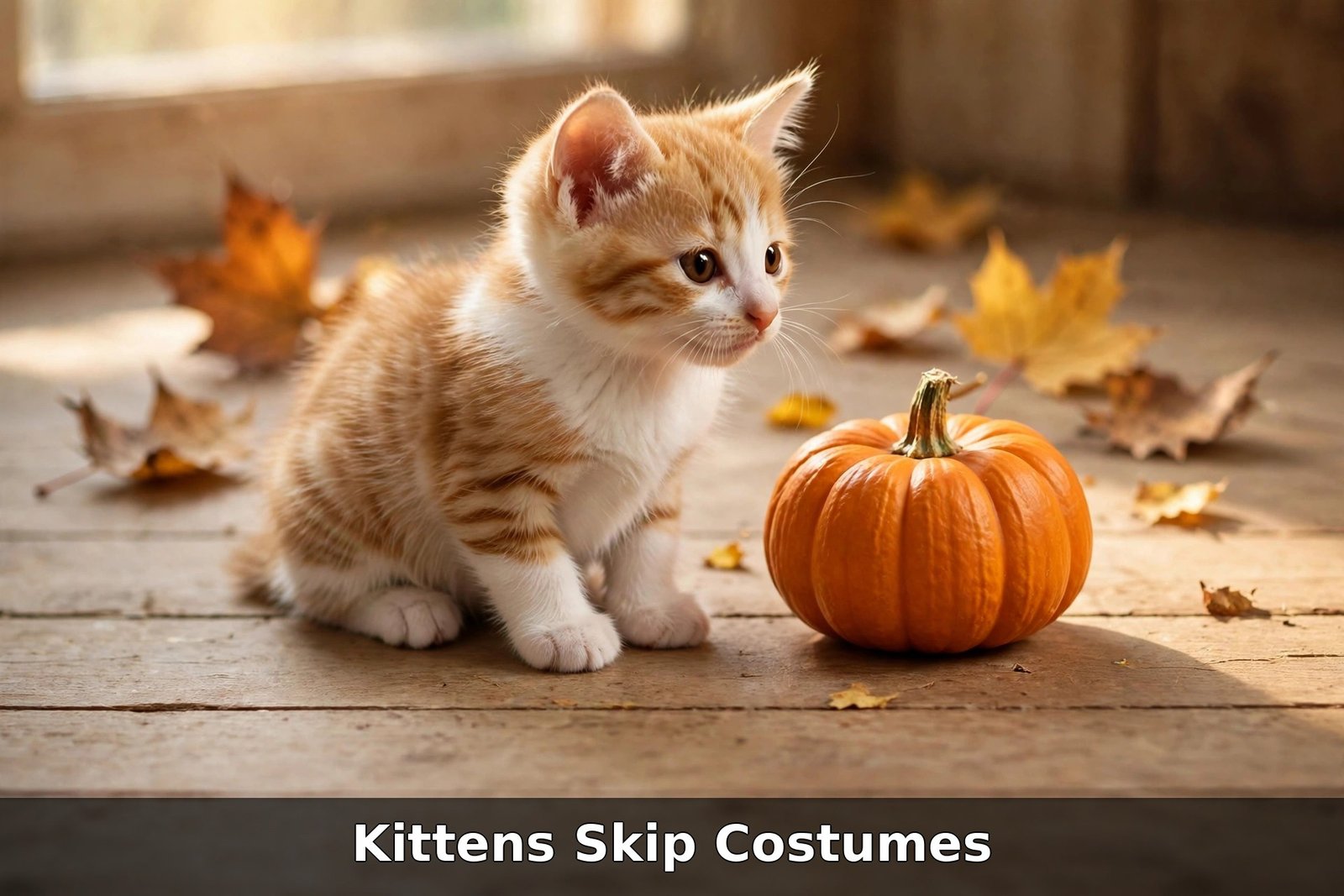
Props beside the kitten, never on the kitten. This is my favorite approach. Set a small pumpkin, a plush ghost, or a festive bandana on the floor next to your kitten and let them investigate on their own terms. A kitten sniffing a mini pumpkin reads “Halloween” just as clearly — and the animal in the photo is genuinely happy. Let the kitten choose the distance.

Costume filters and photo apps. Vetster’s Halloween guide explicitly suggests this: apps that drop your cat into Halloween scenes give you the pumpkin-hat photo with zero stress for the animal. In 2026 the filters are good enough that nobody will know the witch hat was digital.
You dress up; the kitten stays natural. The matching-set loophole: you dress up, the kitten stays natural. Vetster suggests teaming up on a costume that honors the cat’s natural form — a witch whose familiar is just your cat, being a cat. Our matching cat-and-owner Halloween costumes guide is built around this idea, and our DIY cat Halloween costumes guide covers the human side.
A festive breakaway collar — maybe. If your kitten already wears a breakaway collar happily, swapping it for a Halloween-print one is the lowest-friction option in existence. Breakaway is non-negotiable: any collar on a cat must release under pressure. If your kitten doesn’t already wear a collar, Halloween night is not the night to start. For dog-owning households celebrating alongside the kitten, our light-up Halloween dog collar guide covers the festive-collar idea from the canine side.
The First-Halloween Milestone Playbook: Socialization Done Right
Here’s the reframe that changed how I think about a kitten’s first Halloween: the milestone isn’t the costume photo. It’s your kitten’s first experience of a loud, strange holiday — and how you handle it shapes how they feel about novelty for months. A kitten who has a calm, treat-filled Halloween handles Christmas guests and house parties better later.
Run the doorbell drill early. The hardest part of Halloween night for cats isn’t costumes — it’s the parade of strangers at the door. VCA Hospitals recommends keeping your cat in a secured room away from the ringing doorbell, and I’d start a few days early: let your kitten explore the safe room when it’s quiet, feed treats in there, make it the best room in the house. Our guide to keeping cats safe on Halloween walks through the full nighttime routine.
Pair novelty with treats, in short sessions. Five-minute sessions: a new sound at low volume, then a treat. A new decoration, then playtime. Kitten’s choice, always — if they walk away, the session is over, and that’s a win.
Let guests be boring. If friends come over in costume, brief them: ignore the kitten. Let the kitten approach, sniff, and leave — a boring guest is the best socialization outcome you can hope for. If your household also has a puppy experiencing their first Halloween, our puppy’s first Halloween guide covers the canine side of the same milestone.
Kitten-Proofing Your Halloween House
Kittens experience Halloween decorations the way toddlers experience a candy store: everything is new, everything is chewable, and the dangerous stuff is exactly the stuff that dangles.
Candy is off-limits, full stop. VCA’s guidance is unambiguous: chocolate can be toxic to cats depending on quantity and type, candy wrappers can cause blockage, and mints or gum may contain xylitol, which may be toxic. Kittens are more vulnerable on every count. All candy goes in sealed containers, in closed cabinets, from the day it enters the house.
Kill the candles. Candle-lit jack-o’-lanterns plus a kitten with zero impulse control is a burn and fire hazard. VCA suggests battery-powered candles for the same effect — make that a hard rule.
Decorations get the chew test. Fake cobwebs, dangling strings, tinsel, small plastic spiders — everything a kitten can pull down, they will, and everything they pull down goes in the mouth. Kittens of Britain’s rule is practical: keep decorations above counter height and remove dangling threads. Strings and ribbon deserve special fear — they’re one of the most common reasons cats end up in emergency surgery.

Black kittens get extra protection. Black cats face a grim spike in pranks and theft around Halloween. Keep black kittens strictly indoors through the season and away from the open front door on Halloween night. Our black cat Halloween safety guide covers this in full — it’s the one Halloween article I’d call genuinely important.
A quick note on my sources: I’m not a veterinarian, and this isn’t veterinary advice. Every safety claim above comes from vet-published guidance — VCA Hospitals, Vetster, and GeniusVets — plus cat-welfare writing from cats.com and Kittens of Britain. If your kitten eats something suspicious or seems distressed, call your own vet.
FAQ
Should a kitten wear a Halloween costume?
The honest answer is no. VCA Hospitals advises avoiding costumes even for cats who seem fine with dress-up, and Kittens of Britain argues specifically that kittens should skip costumes entirely in favor of supervised play. Kittens chew everything, their coordination is still developing, and the stress usually isn’t worth the photo.
What age is safe for a kitten to wear a costume?
No vet body publishes a “safe costume age,” which tells you something. While your cat is in the chew-everything, startle-at-everything phase — roughly the first year — skip full costumes.
What’s a safe costume alternative for a kitten?
Props placed beside the kitten (never on them), digital costume filters, and you dressing up while the kitten stays natural. A festive breakaway collar is the lowest-friction real option — but only if your kitten already wears a collar happily.
How do I keep my kitten calm on Halloween night?
Set up a safe room away from the front door a few days early, stocked with food, water, a litter box, and familiar bedding. On the night, keep the kitten in there with calming background noise — TV, music, or a fan, per VCA’s guidance.
Are Halloween decorations dangerous for kittens?
More than for adult cats. Kittens chew and climb everything, so fake cobwebs, dangling strings, tinsel, and small plastic decorations are ingestion and entanglement hazards. Keep decorations above counter height and use battery-powered candles instead of real flames.
Can I take my kitten trick-or-treating?
Please don’t. Indoor cats — especially kittens — stay indoors on Halloween. The crowds, costumes, noise, and open doors are a lost-cat scenario waiting to happen, and black cats face additional risks from pranks.
What Halloween treats are safe for kittens?
None of yours — chocolate can be toxic, wrappers can cause blockages, and xylitol in sugar-free candy may be toxic too (per VCA Hospitals). Use their regular treats and keep all human candy sealed away.
The Bottom Line
Your kitten’s first Halloween doesn’t need a costume — it needs a calm house, a safe room, and a human who reads the room instead of the Instagram feed. Skip the outfit, set the props beside the kitten instead of on them, kitten-proof the decorations and the candy, and use the night as a gentle socialization win. A relaxed kitten next to a pumpkin beats any costume shot.
For more seasonal fun, browse the full Pet Halloween hub.
🎄 Visit Our Etsy Shop — Fukroo
Printable Christmas wall art, gift tags & party games — instant download
Shop on Etsy →