
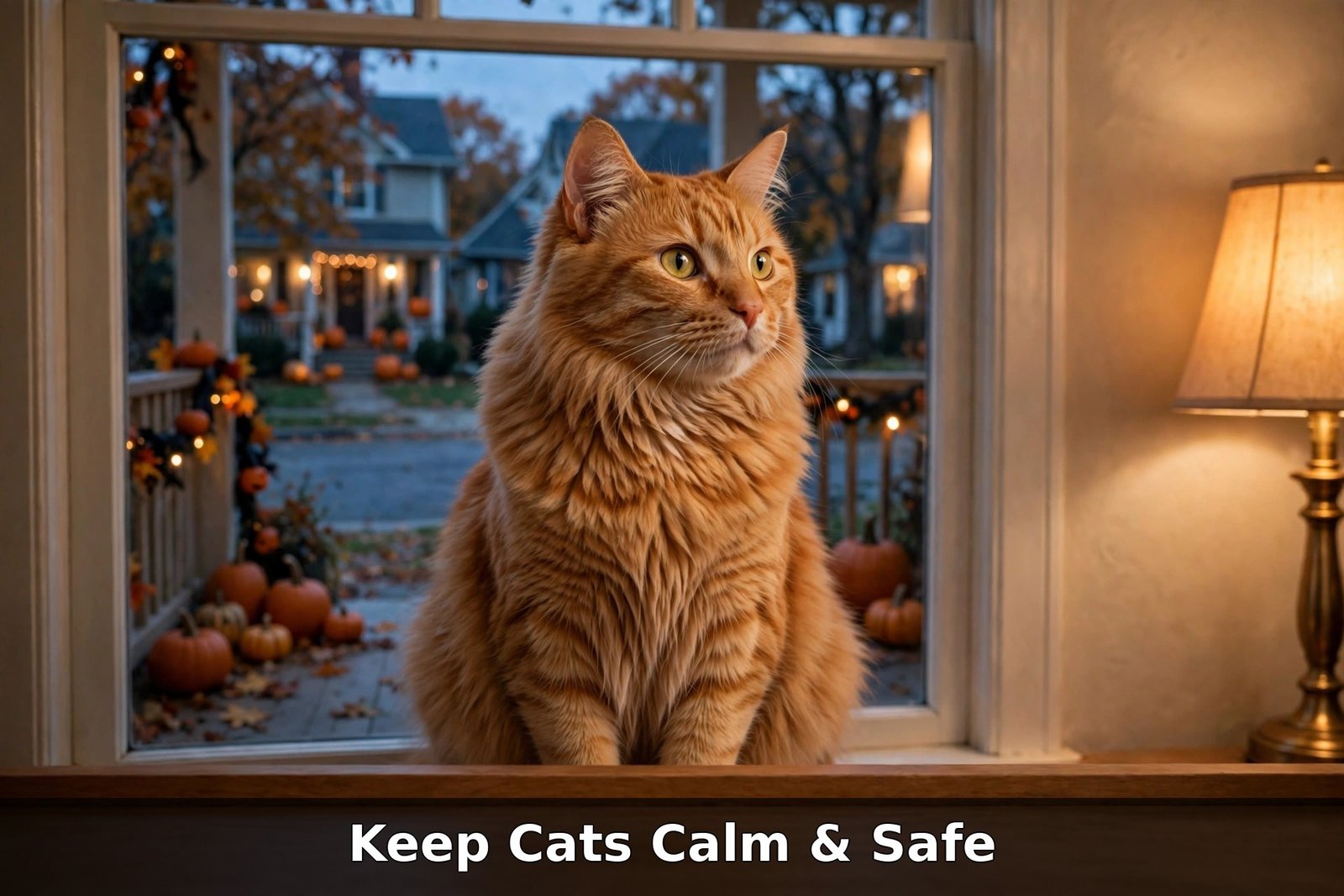
Keeping Cats Safe on Halloween: 12 Tips for a Calm, Escape-Free Night
As an Amazon Associate, Furveko earns from qualifying purchases made through links on this page, at no extra cost to you. See our Affiliate Disclosure.
As an Amazon Associate, Furveko earns from qualifying purchases.
Keeping Cats Safe on Halloween: 12 Tips for a Calm, Escape-Free Night
Here’s the thing about cats and Halloween: your cat has no idea the holiday is happening, and the holiday has no idea your cat is fragile. October 31st is, from a cat’s point of view, the night the door starts opening for no reason, strangers show up smelling like sugar and latex, and everything familiar gets loud. Dogs at least get to be out there with you. Cats are home, alone with the chaos.
This guide is the household-management playbook for getting every cat in your house through October 31st calm, indoors, and unhurt. Twelve tips, ordered roughly the way the night unfolds.
One honest note up front, since it comes up every year: the scary story about black cats being ritually harmed on Halloween is a myth. The ASPCA, National Geographic, and Snopes have all said there’s no evidence for it — we busted it properly in our black cat Halloween safety guide. What follows applies to every cat in the house, black or otherwise: the real dangers — escapes, traffic, candy, candles, stress — don’t check coat color.
Before the Night: Set the Stage
1. Start the indoor stretch days early
If any of your cats go outside, don’t make October 31st the first indoor day. Texas A&M’s veterinary school advises keeping cats indoors for several days before and after Halloween — the whole stretch is noisier, with more traffic, more strangers, and more chaos on the sidewalks. An indoor-outdoor cat yanked inside on the big night spends the evening yowling at the door. Start three or four days out so “inside” feels normal by the time it matters.
2. Get the ID situation sorted now, not at 7pm
Collars fall off. Tag numbers go stale. Microchip registrations sit un-updated for years. Halloween is the highest escape-risk night of the year — the front door opens and closes dozens of times, guests hold it open, kids prop it open. This week, check every cat’s collar fit (two fingers underneath), confirm the tag has your current number, and log into your microchip registry to verify the contact info.
3. Build the calm room before the first knock
Pick a back room — bedroom, office, anywhere far from the front door — and make it the cats’ Halloween headquarters before the evening starts, not after the third doorbell. Food, water, litter box, scratcher, a hiding spot (a box with a blanket works), and something that smells like you. Close the door, and put a sign on it if you have guests. The cats don’t need to see a single trick-or-treater.
4. Hand out candy from the porch, not the doorway
The single smartest logistical move of Halloween night: set up the candy station outside. A chair on the porch, the bowl beside you, greet the kids out there. The front door stays shut all night. No doorbell marathons, no escape sprints through ankles, no stressed cat watching costumed strangers pour into its territory. The doorbell is the enemy of a calm cat; remove the doorbell from the equation entirely.

During the Night: The Real Danger Spots
5. Lock up the candy — all of it, not just the chocolate
Chocolate is toxic to cats, and xylitol — the sweetener in sugar-free candy and gum — is dangerous too. But the part people miss is the rest of it: wrappers, foil, lollipop sticks. Cats are less likely than dogs to gorge, but they’re more likely to chew through something that smells interesting and swallow the wrapper with it. Keep the entire candy operation in one controlled spot, and do a wrapper sweep before bed.
6. Swap real flames for LED everything
Jack-o’-lanterns with actual candles, decorative candles on the mantel, open flames anywhere a cat can jump — all of it goes, or gets swapped for LED tea lights. A curious cat plus an open flame is a singed-whiskers situation at best. LED candles flicker convincingly now, and the cat can’t set anything on fire by walking past one.
7. Audit the decorations with cat eyes
Walk through your decorated rooms at cat height — literally crouch down — and look for what a cat sees: dangling fake spider webs, string lights with chewable cords, tinsel, small props, anything that swings. String-like materials are the classic feline emergency; they can tangle in the intestines, and cats can’t tell your decor from their toys. Keep the chewable stuff high and secured, or skip the fragile decorations in rooms the cats can reach.
8. Keep glow sticks and glow jewelry away from cats
Kids come home with fistfuls of glow sticks and glow necklaces, and cats find them fascinating — right up until they bite through one. The liquid inside isn’t highly toxic, but it tastes awful and causes drooling, frantic pawing at the mouth, and real distress. If a cat chews one, rinse the mouth gently and offer water. The prevention is simpler: glow accessories are kid toys, not cat toys. Collect them at the door and stash them high.

9. If the cat hates the costume, the costume loses
Most cats hate costumes. That’s not a failure of your cat — it’s a species trait. If yours is one of the rare cats that genuinely tolerates a soft accessory, keep it to a bandana, a soft cape, or a lightweight hat for a two-minute photo, then take it off. Watch for the veto signals: flattened ears, freezing in place, trying to claw it off, hiding. And never leave a costumed cat unsupervised — straps and elastic are entanglement risks. If your cat rejects everything store-bought, our DIY cat Halloween costume ideas cover the gentlest no-sew options, and our guide to cat costumes cats actually tolerate is the honest version of this whole conversation.
10. Run the doorbell like a drill, not a surprise
If you’re not doing the porch setup from tip 4, you need a doorbell protocol. Every ring spikes feline stress — sudden loud noise plus strangers invading territory. Options: disconnect the doorbell for the night and put up a “knock softly” sign, run calm music in the calm room for background noise, and brief your guests: no chasing the cat for a costume photo, no opening the bedroom door “to say hi.” The cat’s night is not their entertainment.
Reading the Room (and the Escape Plan)
11. Learn the stress signals before you need them
A stressed cat doesn’t always hide — though hiding is the big one. Watch for flattened ears, dilated pupils, puffed-up fur, hissing at nothing, refusing food, or toileting outside the litter box. Don’t try to comfort by picking the cat up — most stressed cats want space, not a hug. Check that the calm room is still calm, and leave them alone. A cat that spends Halloween night asleep in a closet is having a successful Halloween.
12. Have the escape plan anyway
You did everything right and the cat still slipped out between someone’s legs. Act immediately, not in the morning. Indoor cats that get out usually freeze nearby — check under porches, in bushes, under cars, within a few houses. Bring a flashlight; their eyes reflect. Put the litter box and something that smells like home just outside the door, flag the microchip as lost, and knock on neighbors’ doors on Halloween night — everyone’s outside anyway, which is the one advantage you’ve got.
The Gear Worth Having
Traffic article, soft bridges — three verified listings, each tied to a tip above. The collar guidance follows what vets recommend for Halloween week: breakaway buckle (non-negotiable for cats), reflective or glow visibility, and a current ID tag.
zulinlong 2-Pack Breakaway Cat Collars with Bells, Reflective Strip (adjustable 7.5–12.5″) — Breakaway safety buckles with a reflective night-visibility strip and removable bells, adjustable from 7.5 to 12.5 inches. The two-pack means a spare when one inevitably vanishes under the couch — and it’s the collar style that matches the escape-prevention guidance in tip 2.
KOOLTAIL 6-Pack Breakaway Cat Collars, Glow-in-the-Dark Stars & Moon — Glow-in-the-dark print with breakaway buckles, so the collar carries its own visibility without needing a headlight to bounce off it. Six collars in the pack — handy for multi-cat households, and on-theme for the season without being a costume.
MITOCAPY Hand-Knit Cat Witch Hat — Spider & Black Witch Hat (cotton, adjustable) — For the rare cat that genuinely tolerates one accessory: a soft hand-knit witch hat in cotton with an adjustable fit. This is the “tip 9 approved” bridge — a two-minute photo prop, not a costume, and only for cats that don’t veto it. If your cat says no, skip it with zero guilt.
FAQ
Should I keep my cat indoors on Halloween?
Yes — all cats, not just black ones. Texas A&M’s veterinary school advises keeping cats indoors for several days before and after Halloween, because of traffic, constantly opening doors, and neighborhood chaos. Start the indoor stretch a few days early so it feels normal by the big night.
Why is Halloween dangerous for cats?
The ordinary stuff: open doors and escapes, traffic, chocolate and xylitol in candy, candles and jack-o’-lanterns, chewable decorations, glow sticks if chewed, costume stress, and doorbell-driven panic. All preventable, none of them supernatural.
How do I keep my cat calm when trick-or-treaters come?
Set up a quiet back room before the first knock — food, water, litter box, a hiding spot, something that smells like you. Calm background noise helps. Best move of all: hand out candy from the porch so the front door never opens.
Are black cats really in danger on Halloween?
There’s no evidence of increased ritual harm — the ASPCA, National Geographic, and Snopes all call that story a myth. The real dangers (escapes, traffic, candy, candles) apply to all cats equally. Our black cat Halloween safety guide has the full sourced breakdown.
What are the signs my cat is stressed on Halloween?
Hiding, flattened ears, dilated pupils, puffed-up fur, hissing or growling at nothing, refusing food, and toileting outside the litter box. Give a stressed cat space rather than picking them up — and check that the calm room is still actually calm.
Should I dress my cat up for Halloween?
Only if the cat genuinely tolerates it — most don’t, and that’s normal. A bandana or soft hat for a two-minute photo is plenty. Never leave a costumed cat unsupervised, and if the cat vetoes it, the costume loses.
What should I do if my cat escapes on Halloween night?
Search immediately — indoor cats usually freeze nearby, so check under porches, in bushes, and under cars with a flashlight. Put the litter box and a familiar-scented item outside the door, flag the microchip as lost, and knock on neighbors’ doors on Halloween night while everyone’s outside anyway.
The Bottom Line
Keeping cats safe on Halloween isn’t about one big precaution — it’s about running the evening like a calm operation. Start the indoor stretch early, sort the ID tags this week, build the calm room before the first knock, hand out candy from the porch, and lock up everything chewable, flammable, or toxic. The cat asleep in a quiet back room isn’t missing out. That’s the win.
For more seasonal fun, browse the full Pet Halloween hub.
🎄 Visit Our Etsy Shop — Fukroo
Printable Christmas wall art, gift tags & party games — instant download
Shop on Etsy →





2 Comments