

How to Keep Your Dog Calm on Halloween Night (Doorbell, Costumes & Trick-or-Treaters)
As an Amazon Associate, Furveko earns from qualifying purchases made through links on this page, at no extra cost to you. See our Affiliate Disclosure.
As an Amazon Associate, Furveko earns from qualifying purchases.
How to Keep Your Dog Calm on Halloween Night
For us, Halloween is one fun evening. For a dog, it can be the strangest night of the year: the doorbell rings forty times, small humans in masks keep appearing at the door, the house smells like candy, and everyone’s acting weird. If your dog spends October 31st barking, pacing, hiding, or shaking — that’s not bad behavior. That’s a dog telling you the night is too much.
The good news: a calm Halloween night is mostly about preparation, not luck. Almost everything that stresses dogs on Halloween is predictable — and that means you can plan for it. Here’s the full playbook, from the week before to the last trick-or-treater.
Why Halloween Stresses Dogs Out
It helps to see the night through your dog’s eyes. Dogs are creatures of routine, and Halloween breaks every routine at once:
- The doorbell becomes a slot machine. It rings, strangers appear, excitement happens, it rings again. For a territorial or anxious dog, each ring restarts the stress cycle before the last one finished.
- Costumes break the “human” template. Dogs read faces and body language. A mask, a tall hat, or a billowing cape turns a familiar neighbor kid into an unrecognizable shape — and dogs are wired to be cautious about unrecognizable shapes approaching their home.
- Noise stacks up. Screams of delight, spooky soundtracks, fireworks in some neighborhoods. Dogs hear far more of it than we do.
- Their people act strange. You’re wearing something odd, you’re excited, you’re handing things to strangers. Your dog takes emotional cues from you, and “my human is acting weird” is its own stressor.
None of this means your dog is broken or badly trained. It means the night is objectively a lot.
The Week Before: Desensitize and Practice
You can’t fix Halloween on Halloween. The real work happens in the days before.
Desensitize the doorbell. A few times a day, ring your own doorbell (or play a doorbell sound on your phone), then immediately do something boring — give a treat, ask for a sit, carry on. The goal is to uncouple the sound from the chaos. Ten short reps a day for a week genuinely moves the needle for many dogs.
Practice the costume. If your dog is wearing a costume — or if visitors will be — do dress rehearsals. Put the costume on for five minutes, treats rain down, costume comes off. If a friend can visit in a mask for a two-minute treat party, even better. Our guide to Halloween costumes for dogs that hate costumes is built around exactly this low-pressure approach.
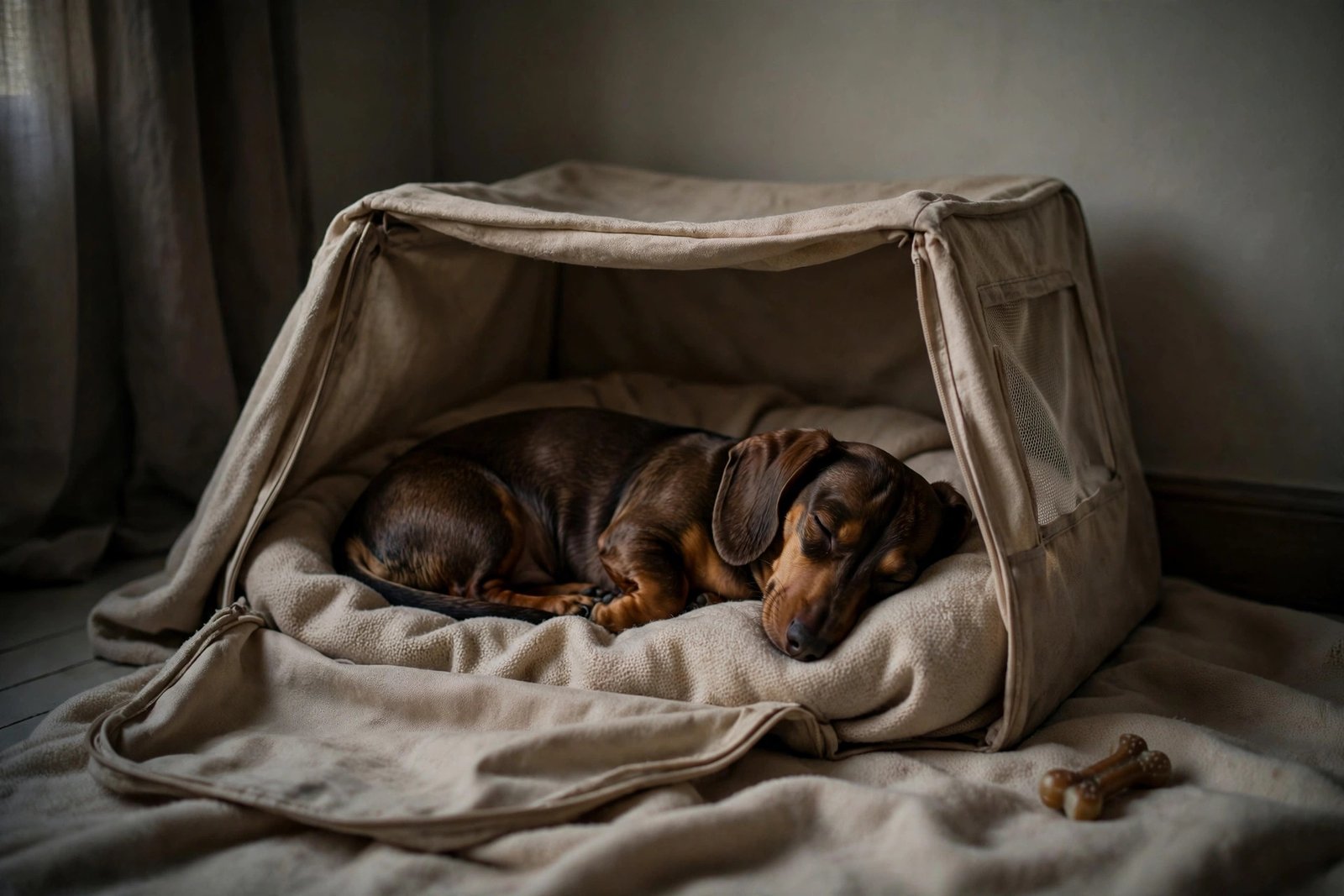
Set up the safe room now, not on the night. Pick the quietest room farthest from the front door. Put your dog’s bed or crate there, a worn t-shirt that smells like you, water, and a long-lasting chew. Let your dog hang out there happily before Halloween so the room already feels like a good place.
Halloween Day: The Plan
Exercise early and well. A tired dog is a calmer dog — this is the single highest-leverage thing you can do. Take the long walk, do the fetch session, run the brain games in the morning or early afternoon, well before the evening chaos. A dog who has already burned off the day’s energy has less fuel for anxiety.
Feed on schedule. Don’t skip or delay dinner hoping your dog will be “too hungry to be nervous.” An off-schedule meal on top of a chaotic evening just adds another disruption. Feed at the normal time, in the normal spot.
Walk in daylight, not at dusk. If your neighborhood does evening trick-or-treating, get the last walk done before costumes hit the sidewalks. A leashed encounter with a seven-foot inflatable ghost dinosaur is nobody’s idea of a relaxing stroll.
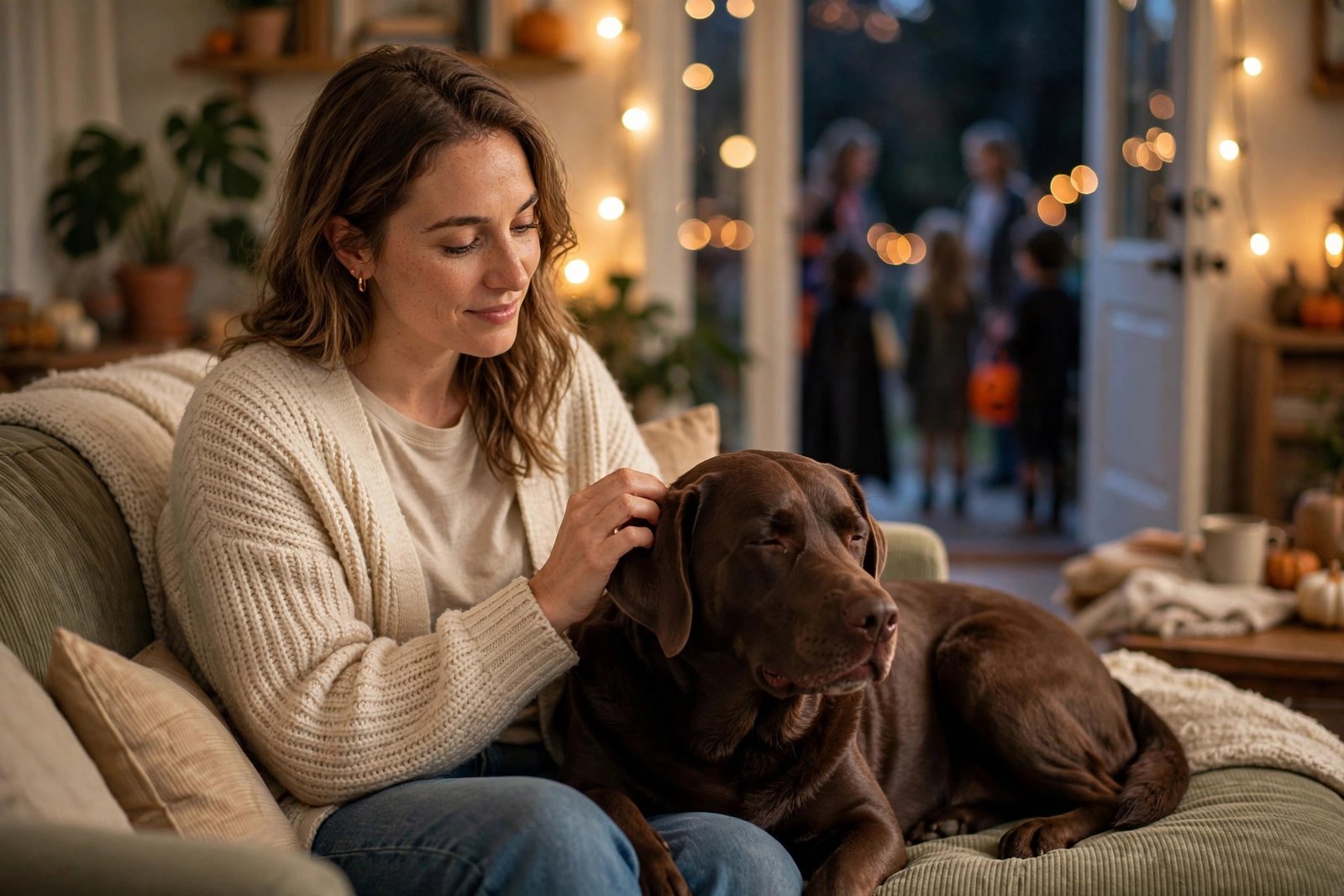
The Doorbell Protocol (Your Halloween Night System)
Here’s the system that works for most households. Pick the pieces that fit yours:
- Move the party away from the door. Set up your candy station on the porch, in the driveway, or at the end of the walkway if you can. Every foot of distance between trick-or-treaters and your dog is less stress.
- Gate or close off the entryway. A baby gate across the hallway keeps your dog from rehearsing the door-rush forty times. Less rehearsal, less arousal.
- Put up a sign. “Please knock softly — sleeping dog!” or “Take candy from the bowl, no need to ring!” Most visitors happily comply, and it cuts your doorbell rings dramatically.
- Use the safe room. When the rush starts, your dog goes to the prepared room with a stuffed Kong or lick mat, calming music or white noise on, door closed. This isn’t punishment — it’s a quiet green room away from the show.
- Keep greetings boring. When you do answer the door, keep your own energy low. No squealing, no big reactions. Your dog is watching you for cues about whether this is exciting or fine.
The enrichment angle matters here. A puzzle or burrow toy from our Halloween toy roundup — something your dog has to nose and work at — gives an anxious dog a job during the chaos. Sniffing and licking are naturally calming behaviors; a dog working a stuffed toy is a dog not rehearsing panic.
Managing Trick-or-Treaters (and Their Costumes)
You can’t control what shows up at your door, but you can control the interaction:
- Treat the bowl, not the door. A self-serve candy bowl on the porch means fewer knocks and zero face-to-face costume encounters at your threshold.
- Keep your dog out of costume photos with strangers. Kids in masks leaning over a nervous dog is a bite-risk scenario. Your dog’s Halloween photo ops should be with family only — see our two-dog duo costume ideas for safe, at-home photo fun.
- Watch for candy drops. Excited kids drop candy. Chocolate and xylitol (in sugar-free candy) are the real dangers — sweep the porch and entryway during the night, and keep the candy bowl high and latched.
When Anxiety Is Serious: Talk to Your Vet
Everything above handles normal Halloween stress. But some dogs aren’t just stressed — they’re in genuine distress: relentless panting, drooling, shaking, trying to escape, or shutting down completely. If that sounds like your dog, talk to your veterinarian — ideally before Halloween, not during it.
I’m not going to diagnose your dog or recommend medications here, because that’s your vet’s job. What I will say: vets have real options for situational anxiety, from behavioral plans to short-term prescriptions, and the appointment needs to happen days or weeks ahead — not at 7pm on October 31st. If your dog’s Halloween history includes panic, make the call now. There’s no prize for white-knuckling through it.
Worth Having on Hand
A quick note on products: nothing here cures anxiety. But some owners find these useful as part of the bigger plan above — the safe room, the exercise, the doorbell protocol.
ADAPTIL Calming Pheromone Diffuser (30-Day Starter Kit)
ADAPTIL is a plug-in diffuser that releases a synthetic version of the pheromone mother dogs produce when nursing — the idea is that it signals “safe” to the dog’s brain. It’s one of the more widely used calming aids out there (the listing sits around #260 in Dog Relaxants on Amazon), and the honest framing is this: some owners swear by it, the evidence is mixed, and it’s best thought of as one layer in a calming plan, not the plan itself. Plug it into the safe room a day or two before Halloween so it’s running when the chaos starts.
ADAPTIL Calming Pheromone Diffuser 30-Day Starter Kit — Plug-in pheromone diffuser some owners use for situational stress; one layer of a bigger calming plan, not a cure.
LickiMat X Large Soother Lick Mat
This one’s simpler and I like it better: a textured mat you spread with peanut butter, yogurt, or wet food. Licking releases calming endorphins, and a frozen LickiMat can buy you 20–30 minutes of focused, relaxed activity — exactly the window when the doorbell is at its worst. It’s the practical version of “give the dog a job.” Smear it, freeze it in the afternoon, deploy it in the safe room when the first trick-or-treaters arrive.
LickiMat X Large Soother Lick Mat — Textured lick mat for doorbell-distraction licking; smear, freeze, and deploy during peak trick-or-treat hours.
FAQ
Why is Halloween stressful for dogs?
The doorbell rings constantly, strangers in unrecognizable costumes appear at the door, noise levels spike, and the household routine breaks — all in one evening. Dogs are creatures of routine who read faces and body language, so Halloween hits them on multiple stress channels at once.
What should I do if my dog hides or shakes when trick-or-treaters come?
Let them. Don’t drag a hiding dog out — give them their safe room with their bed, something that smells like you, and calming background noise. Hiding is a coping strategy, not misbehavior. Sit with them quietly if your presence helps, or leave them be if they settle better alone.
How do I stop my dog barking at kids in costumes?
Desensitize before Halloween: short, treat-heavy practice sessions with the doorbell sound and with people in odd clothing. On the night itself, manage the environment instead of fighting it — gate off the entryway, use a “no need to ring” sign, and settle your dog in the safe room with an enrichment toy.
Should I keep my dog away from the front door on Halloween night?
Yes — for most dogs, this is the single best move. A baby gate or a closed door between your dog and the entryway prevents forty repetitions of the door-rush, and a “please knock softly” sign cuts the trigger at its source. Distance is a legitimate training tool.
What calming products actually help dogs on Halloween?
The honest answer: management beats products. But as part of a plan, owners commonly use pheromone diffusers, lick mats with frozen fillings, long-lasting chews, and white noise or calming music. Nothing replaces the safe room, the early exercise, and keeping your own energy low.
Should I walk my dog on Halloween evening?
Walk in daylight instead. Get the big walk done in the morning or afternoon to burn energy, and do the last outing before costumes hit the sidewalks. An evening walk through trick-or-treat crowds is stressful for most dogs and risky around dropped candy.
The Bottom Line
A calm Halloween night isn’t luck — it’s a system. Desensitize the doorbell in the week before, exercise early on the day, move the candy away from the door, gate off the entryway, and give your dog a quiet safe room with a real job to do (a frozen lick mat beats a bare floor every time). Keep your own energy boring, keep costumes and strangers at a distance, and call your vet ahead of time if your dog’s anxiety goes beyond normal stress. Do the prep, and October 31st can be just another cozy night in — with better snacks for you.
For more seasonal fun, browse the full Pet Halloween hub.
For the remedy side — calming vests, pheromone diffusers, supplements and vet options for both dogs AND cats — see our Halloween pet anxiety guide.
🎄 Visit Our Etsy Shop — Fukroo
Printable Christmas wall art, gift tags & party games — instant download
Shop on Etsy →




2 Comments