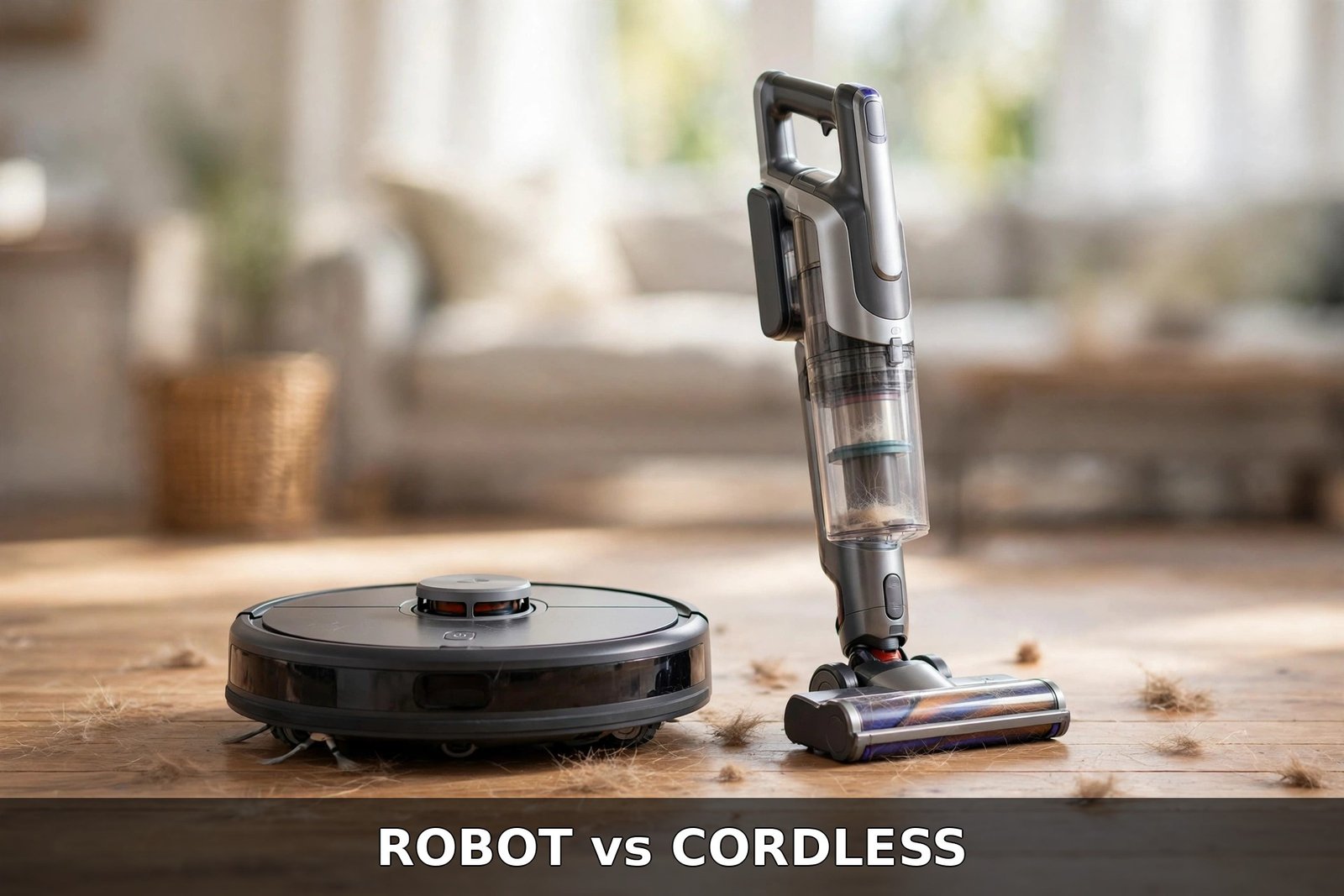
Robot Vacuum vs Cordless Vacuum for Pet Hair: Which to Buy?
As an Amazon Associate, Furveko earns from qualifying purchases made through links on this page, at no extra cost to you. See our Affiliate Disclosure.
Affiliate Disclosure: This article contains affiliate links. If you buy through a link on this page, Furveko may earn a small commission at no extra cost to you — we use the tag furveko-20 on Amazon. It never changes which products we recommend.
Sooner or later every dog owner reaches the same breaking point. You have vacuumed — dragged-everything-out-from-under-the-sofa vacuumed. Two days later a faint grey halo of fur is back along the baseboards. And then the painful question: you can afford one good machine. Should it be the robot that cleans while you are at work, or the stick you push yourself?
I have run both in homes with real shedders. There is no universal winner — only the right answer for your floors, your dog, and how your week actually goes. Here is the honest comparison.
Quick Verdict
Quick Verdict
Buy a robot vacuum if you want hair managed every single day with zero effort — mostly single-storey, hard floors, low-pile rugs. Set the schedule and forget it.
Buy a cordless stick vacuum if you have stairs, a car the dog rides in, thick carpet, or a heavy shedder, and you want one machine for everything — including spots a robot physically cannot reach.
Our take: A robot wins on consistency — daily control beats a heroic weekly clean. A stick wins on completeness. If you can only buy one and you have stairs, buy the stick.
See our best vacuum for dog hair on hardwood floors for the top picks by floor type.
At a Glance
| Feature | Robot Vacuum | Cordless Stick Vacuum |
|---|---|---|
| Daily hair control | Excellent — runs on schedule, you do nothing | Great, but only when you pick it up |
| Deep clean | Good on hard floors and low-pile rugs; weaker on thick carpet | Stronger suction, better carpet agitation |
| Stairs and car | Cannot do them | Handles stairs, car, couch cushions, vents |
| Noise | Moderate hum, you can leave the house | Louder up close, but you control when |
| Maintenance | Empty bin/chamber often, cut wrapped hair off brush, clean sensors | Empty bin, occasional filter rinse, cut wrapped hair |
| Cost over a year | Higher up front, self-empty models add bag costs | One buy, nearly zero running cost |
| Best for | Busy owners, daily tidiness, single floors | Complete coverage, one-machine homes |
The honest truth most reviews skip: these two were never designed to replace each other. One is a housekeeper, the other is a toolbox.
Robot Vacuum — The Set-and-Forget Housekeeper
A robot vacuum’s real superpower is not suction. It is schedule.
Dog hair does not arrive in one dramatic pile. It accrues — a whisper of fur per day that crosses from “fine” into “embarrassing” around day four. A robot that runs at 11 a.m. every weekday never lets day four happen. That consistency is the single biggest upgrade of any vacuum type for pet owners.
Modern pet-focused models handle the classic headaches better than the early ones did: anti-tangle brush rollers, real mapping instead of hallway loops, and self-emptying docks that turn bin-emptying into a monthly chore.
Two worth knowing:
Roborock Q7 M5+ — mid-range robot with a self-empty dock, mopping, and a brush roller designed for fewer hair-wrap problems. The dock is the part that makes the daily schedule feel effortless.
Check Price on Amazon — Roborock Q7 M5+
iRobot Roomba 694 — the budget workhorse. No mapping, no self-empty dock, just a proven Roomba that picks up hair. The honest entry point.
Check Price on Amazon — iRobot Roomba 694
But go in with clear eyes. A robot cannot do stairs or your car, treats thick carpet like a mild suggestion, and will eat a phone charger left on the floor. With a heavy shedder the bin fills fast — a robot that fills up on Tuesday and sits silently until Saturday is doing nothing. A self-empty dock solves that.
Pros
– Cleans daily on a schedule with zero effort from you
– Hair never accumulates to embarrassing levels
– Quiet enough to run while you work or sleep
– Great on hard floors and low-pile rugs
Cons
– Cannot do stairs, cars, upholstery or high surfaces
– Weaker on thick carpet than a stick
– Eats cords, socks and dog toys left on the floor
– Heavy shedders need a self-empty dock or frequent bin emptying
Cordless Stick Vacuum — The Do-Everything Tool
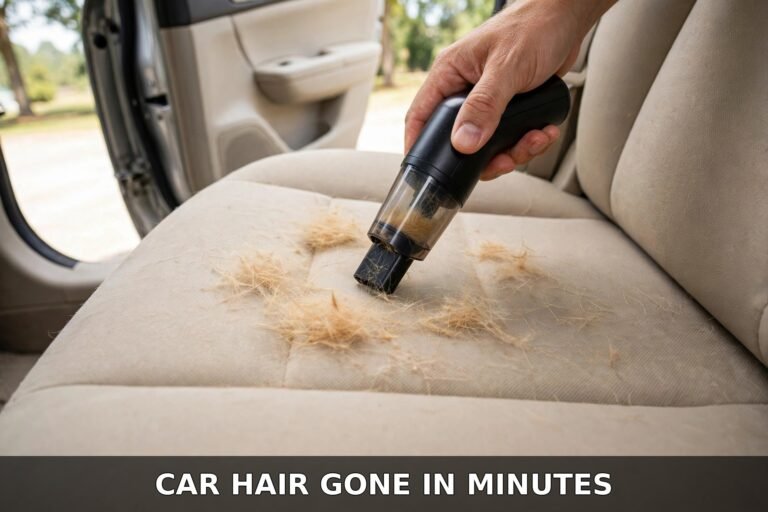
A cordless stick is the opposite philosophy. Nobody is cleaning for you. But when you grab it, there is almost nowhere it will not go — stairs, the car the dog rides in, couch cushions, the dog’s bed, the rug that collects everything.
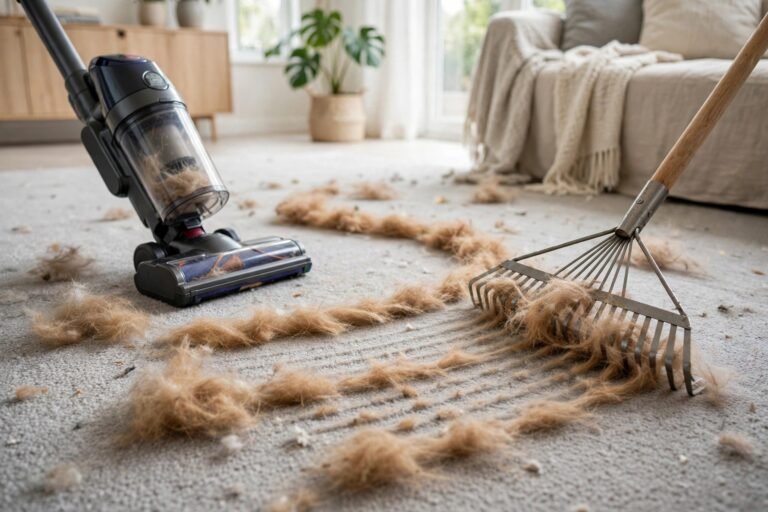
Suction matters too. Sticks pull harder and agitate carpet better: a motorised stick head digs embedded fur out of thick rugs that a robot just glides over. Carpet-heavy home? That alone settles it.
The example that anchors this category:
Shark Stratos Cordless (IZ862H) — Shark’s flagship cordless line, with Clean Sense IQ that adjusts suction to hidden dirt and a self-cleaning brush roll aimed at pet hair wrap. Tens of thousands of ratings on Amazon make it one of the most-bought cordless sticks in the country.
Check Price on Amazon — Shark Stratos IZ862H
The downside is you. A stick is a promise you make with yourself, and most people break it by week three. The battery lasts 20–40 minutes depending on mode, which suits a flat but means charging breaks in a two-storey house.
Pros
– Goes everywhere: stairs, car, cushions, vents, thick carpet
– Stronger suction and carpet agitation than a robot
– One machine genuinely covers the whole house
– Minimal running cost
Cons
– You have to do the work — consistency depends on your habits
– Battery limits long sessions; big homes need a recharge break
– No help when you are away all day
When Each One Wins
One-floor flat, mostly hard floors, out all day: Robot, and it is not close. It cleans while you are gone and you come home to hair that never accumulates. A stick in this home sits in the corner getting guilty looks.
Two-storey house with stairs: Stick. A robot does half the house — you will be hand-cleaning the stairs anyway, and at that point the robot is a very expensive kitchen sweeper.
Heavy shedder (Husky, Golden, German Shepherd): If one — the stick for raw hair-removal power, or a robot with a self-empty dock, since a heavy shedder fills a robot bin in a day or two.
Thick carpet throughout: Stick. Robots struggle with deep pile; a motorised stick head digs out fur a robot leaves behind.
You travel and the dog stays with a sitter: Robot. The schedule keeps running while nobody else will vacuum for your dog.
Cost Over a Year
Prices change often, so think in patterns rather than price tags.
A robot is the bigger upfront spend, and self-emptying models add replacement bags to the running cost — a few dollars a month. Budget robots cost less up front but ask for more of your time.
A stick is usually cheaper than a premium robot, and running cost is close to zero: rinse the filter now and then, and it is good for years.
Over a year, the stick is the cheaper total. But price is not value. A robot you paid more for that runs daily is better value than a stick you paid less for and use twice a month. Buy for the habit you will actually keep.
Tips for Better Results — Whichever You Choose
Going robot: Clear the floor before its first run — cords, socks, dog toys. Run it daily, not weekly; that is the whole point. Heavy shedder? The self-empty dock is not a luxury — it is the difference between a robot that works and one that fills up and naps.
Going stick: Pick a schedule and keep it — every other day beats a heroic monthly session. Vacuum carpet in two directions, empty the bin before it is packed, and do stairs with the crevice tool weekly — stair edges collect hair that looks terrible in sunlight.
Both: work on dry floors — damp floors make hair cling. And brush the dog itself: less loose hair at the source means less work for whatever machine you buy.
Frequently Asked Questions
Can a robot vacuum replace a stick vacuum with dogs?
For single-floor homes with hard floors, mostly yes — daily scheduling keeps things tidy. But it cannot do stairs, cars, or upholstery, so a stick is still needed for complete coverage. Most happy dog homes eventually own both: the robot does daily maintenance, the stick does the details.
What is anti-tangle brush technology, and does it matter?
Dual rollers or brush geometry that channels hair to the ends instead of wrapping the middle. It matters a lot with long-haired breeds — without it, brush maintenance becomes a weekly annoyance.
Which is better for thick carpets — robot or stick?
A stick, clearly. Robots have modest suction and shallow agitation; a stick’s motorised brush head digs embedded fur out of deep pile that a robot glides over.
I can only buy one. Which should it be?
Count your stairs and think about your car. Stairs or a dog that rides in the car? Buy the stick. One floor, hard floors, and you are gone all day? Buy the robot. If you honestly will not vacuum three times a week, the robot buys you the habit you would not keep.
Final Verdict
The robot is the better housekeeper: daily, automatic, relentless about the slow accumulation of fur that makes dog homes look tired. The stick is the better cleaner: more powerful, more versatile, and the only one of the two that handles stairs, cars and thick carpet properly.
Buy the robot if your life is one floor, mostly hard floors, and a schedule that keeps you out of the house. Buy the stick if your hair problem lives where a robot cannot go.
And if you ever get both? The robot runs at 11, the stick comes out on weekends for the stairs and the car, and the dog sheds anyway — but nobody can tell.
Also worth reading: the best budget robot vacuum for pet hair if the robot side won you over, or how to remove dog hair from carpet for deep-clean techniques a stick alone will not fix.
🎄 Visit Our Etsy Shop — Fukroo
Printable Christmas wall art, gift tags & party games — instant download
Shop on Etsy →